1.1 The Complex Plane
It is natural to associate the complex number \(z = x + iy\) with a point in the plane whose Cartesian coordinates
are \(x\) and \(y\). The number \(z\) can be thought of as a directed line segment or a vector from the origin, to the
point \((x,y)\).
Definition 1.4. Let \(z = x + iy\) be any complex number then the modulus of \(z\) denoted \(\left |z\right |\) is the non-negative real number \(\, \left |z\right | = \sqrt {x^2 + y^2}\)
Remark 1.5. While the statement \(\, z_1 < z_2\,\) is in general meaningless, \(\,\left |z_1\right | < \left |z_2\right |\,\) means that the points corresponding to \(z_1\) is closer to the origin than the point corresponding to \(z_2\).
Definition 1.6. The distance between the points representing the complex numbers \(z_1\) and \(z_2\) is given by \[\left |z_1 - z_2\right | = \sqrt {(x_1 -x_2)^2 + (y_1- y_2)^2}\]
It is important to note that
- 1.
- \(\left |z\right |\) distance in the complex plane of a complex number from \(0\).
- 2.
- \(\left |z_1 - z_2\right |\) distance in the plane from \(z_1\) to \(z_2\)
- 3.
- \(z\cdot \overline {z} = \left |z\right |^2\quad \) i.e \(\quad \left |z\right |^2 = \big (Re z\big )^2 + \big (Im z\big )^2\)
- 4.
- \(\operatorname {Re} (z) \leq \left |\operatorname {Re}(z)\right | \leq \left |z\right |\,\) and \(\, \operatorname {Im} (z) \leq \left |\operatorname {Im} (z)\right | \leq \left |z\right |\)
- 5.
- \(\left |z_1 + z_2\right | \leq \left |z_1\right | + \left |z_2\right |\,\) triangle inequality and the equality holds if and only if \(z_1\) and \(z_2\) lie on the same (half ray)
through the origin in the complex plane.
Example 1.7. Describe the set of points \(z\) in the complex plane that satisfy \(\, \left |z\right | = \left |z - i\right |\)
Solution
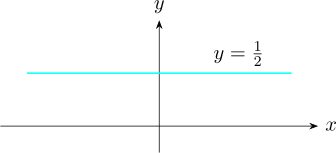
Let \(\, z = x + iy\,\) then \begin {align*} \left |z\right | & = \left |z - i\right |\\\\ \implies \quad \left |x + iy\right | & = \left |x + iy - i\right |\\ \implies \quad \sqrt {x^2 + y^2} & = \sqrt {x^2 + (y - 1)^2 }\\ x^2 + y^2 & = x^2 + (y - 1)^2\\ y^2 & = y^2 - 2y + 1\\\\ \implies \quad y = \frac {1}{2} \end {align*}
Since the equality is true for arbitrary \(x\), \(\, y = \frac {1}{2}\) is an equation on the horizontal line. This the complex numbers satisfying \(\,\left |z\right | = \left |z - i\right |\,\) can be written as \(\, z = x + \frac {1}{2}i\)
Questions on this section
Stuck on something here? Ask below and it stays attached to this topic.