16.1 Unobserved heterogeneity
Consider \(N\) units observed for \(T\) periods, with the model \[ y_{it} = x_{it}'\beta + z_i'\gamma + \alpha _i + \varepsilon _{it}, \qquad i = 1, \dots , N, \quad t = 1, \dots , T, \] where \(x_{it}\) varies over time, \(z_i\) does not, \(\alpha _i\) is an unobserved individual effect, and \(\varepsilon _{it}\) is an idiosyncratic disturbance. We assume strict exogeneity: \(E(\varepsilon _{it} \mid x_{i1}, \dots , x_{iT}, z_i, \alpha _i) = 0\) for all \(t\), so that the disturbance in any period is unrelated to the regressors in every period. The asymptotics are for \(N \to \infty \) with \(T\) fixed, the usual situation in microeconomic panels.
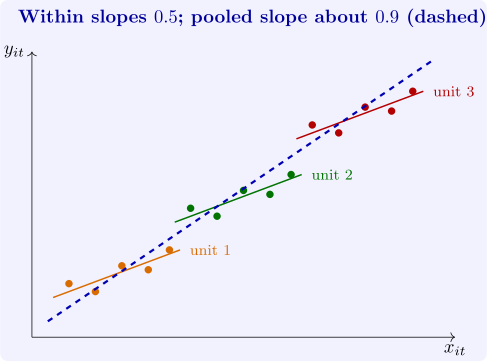
If \(\alpha _i\) is uncorrelated with the regressors, pooled least squares on all \(NT\) observations is consistent, though its standard errors must allow for the correlation that \(\alpha _i\) induces between the disturbances of the same unit. If \(\alpha _i\) is correlated with \(x_{it}\), it is an omitted variable, and pooled least squares is inconsistent by Theorem 8.1.1. In an earnings equation, unobserved ability raises wages and is correlated with schooling and training; in a production function, management quality raises output and is correlated with the inputs. The two models of this section correspond to these two cases.
Questions on this section
Stuck on something here? Ask below and it stays attached to this topic.