1.3 Types of epidemiological study
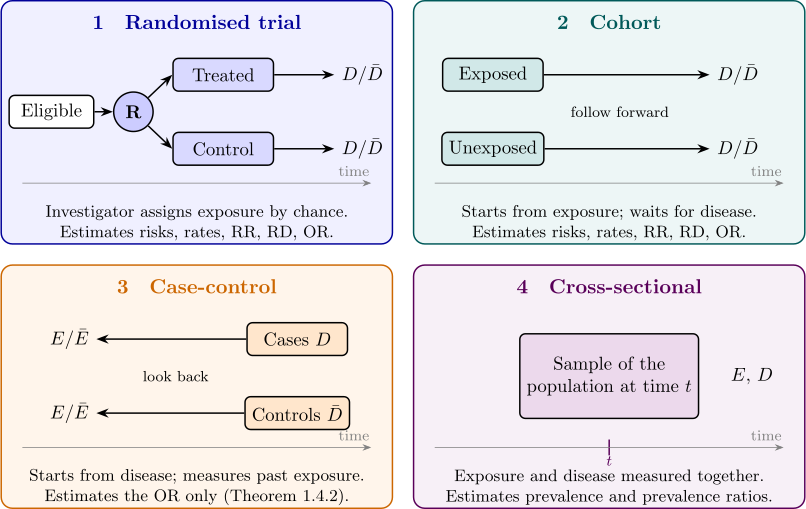
Studies are classified first by whether the investigator assigns the exposure, then by how the subjects are selected and in which direction in time they are followed (Figure 1).
Experimental studies
In a randomised controlled trial the investigator assigns the exposure (usually a treatment) by a chance mechanism and follows the groups to compare outcomes. Randomisation makes the groups comparable, in distribution, in every characteristic measured or not, which is why the trial is the standard against which observational designs are judged. A field trial randomises healthy people to a preventive measure (a vaccine, a dietary supplement); a community trial randomises whole communities (fluoridation of water, a health-education campaign). Trials are possible only for exposures that are expected to do good, or at least no harm; nobody may be randomised to asbestos.
Cohort studies
A cohort study identifies exposed and unexposed people who are free of the disease and follows them over time to record who develops it. It may be prospective (follow-up runs from now into the future) or historical (retrospective): exposure is reconstructed from past records, such as employment files, and follow-up from then to now is done through death registers. In either case the logical direction is from exposure to disease. Cohort studies measure risks and rates directly, can study many diseases after one exposure, and establish that exposure came before disease. They are expensive and slow for rare diseases: to see \(50\) cases of a disease with annual rate \(10^{-4}\) needs half a million person-years.
Case-control studies
A case-control study starts at the other end. It collects people with the disease (cases) and a sample of people without it (controls) from the population that produced the cases, then compares their histories of exposure. It is fast and cheap for rare diseases, which is why most of what is known about the causes of cancer first came from case-control studies. Its weaknesses are that exposure is often recalled after diagnosis, when cases may remember differently from controls, and that choosing controls who truly represent the source population of the cases is difficult. As Section 1.4 shows, it cannot estimate risks, only odds ratios.
Cross-sectional and ecological studies
A cross-sectional study, also called a prevalence study, records exposure and disease in a sample of a population at one time. It estimates prevalence and is the natural design for planning health services. Because it counts existing cases, it confuses the causes of getting a disease with the causes of having it for a long time, and it often cannot tell whether exposure came first.
An ecological study uses groups, not individuals, as the unit of analysis: countries, districts, years. It relates the disease rate of each group to the average exposure of the group, for instance the lung cancer rate of each country to its cigarette consumption per head. The data are cheap, often already published, but associations between groups need not hold for the individuals in them (Example 1.5.4).
Questions on this section
Stuck on something here? Ask below and it stays attached to this topic.