4.1 Introduction
A hypothesis test involves a separation of the parameter space \(\Omega \) into two distinct regions, \(\Omega _0\) and \(\Omega - \Omega _0\).
This partition of the parameter space corresponds to testing the null hypothesis that the
parameter is in \(\Omega _0\).
\[\text {i.e}\hspace {0.3cm} H_0:\, \theta \in \Omega _0.\]
The null hypothesis is usually the status quo and it is only rejected if there is reasonably strong
evidence against it.
The alternative hypothesis determines what departures from the null hypothesis are
anticipated.
\[\text {i.e}\hspace {0.4cm} H_1:\, \theta \in \Omega - \Omega _0\]
Since the true value of the parameter is unknown, we base our decision on the observed value of \(X\)
by dividing the sample space into the critical region or rejection region \(R\) and its complement \(R^C\) called
the acceptance region.
We declare that \(H_0\) is false (in favor of the alternative) if we observe \(x\in R\).
Definition 4.1.1. The power function of a test with a critical region \(R\) is the function \[\beta (\theta ) = P_{\theta }\left (X\in R\right )\] or the probability that the null hypothesis is rejected as a function of the parameter.
Note. In order to minimize the two types of errors, the power function \(\beta (\theta )\) is expected to be small for \(\theta \in \Omega _0\) but large otherwise.
Definition 4.1.2. A test has level of significance \(\alpha \) if \(\beta (\theta ) \leq \alpha \) for all \(\theta \in \Omega _0\).
Note. The level of significance is simply an upper bound on the probability of a type I error. There is no assurance that the upper bound is tight, that is equality is achieved. The lowest such upper bound is often called the size of the test.
Definition 4.1.3. The size of a test is equal to \(\,\,\sup _{\theta \in \Omega _0}\beta (\theta )\).
Example 4.1.4. Suppose a coin is tossed 1000 times. Let \(x\) be the number of heads. Suppose we want to test whether the coin is fair.
Solution. \(X \, \thicksim \, BIN(1000,\theta )\)
\[\Omega = \{\theta |\, 0 < \theta < 1\}\]
\(H_0:\, \theta = \frac {1}{2}\,\) (simple hypothesis) or \(\Omega _0 = \{\frac {1}{2}\}\)
\(H_1:\, \theta \neq \frac {1}{2}\,\) or \(\, \theta \in \Omega - \Omega _0\,\) (composite hypothesis).
Suppose the critical region is \(R = \{x|\, x \leq 469 \) or \( x \geq 531\} = \{x|\, |x - 500|> 30\}.\)
Sample space \( = R\cup R^C\, = \{x|\, x = 0, \, 1, \, \cdots \, , \, 1000\}.\)
If we observe \(x\in R\) we reject \(H_0\) in favour of \(H_1\). \[\text {Type I error}\, = \, \text {reject}\, \, H_0\,\, \text {if}\, \, H_0\, \, \text {is true}\] \begin {align*} P\left (\text {Typer I error}\right ) & = P\left (X \in R|\, H_0\, \, \text {is true}\right )\\ & = P\left (\left |X - 500\right | > 0 \, |\, \theta = 1/2\right )\\ & \approx 2P\left (X < 469.5\, |\, \theta = 1/2\right )\\ & = 2P\left (\frac {X - n\theta }{\sqrt {n\theta (1 - \theta )}} \, \leq \, \frac {469.5 - 500}{\sqrt {250}}\right )\\ & = 2\, P\left (Z < -1.93\right )\\ & = 0.054. \end {align*}
\begin {align*} \beta (\theta ) & = P_{\theta }\left (X\in R\right ) = P_{\theta }\left (|X - 530|\, > 30\right )\\ & = P_{\theta }\left (X\leq 469\right ) + P_{\theta }\left (X\geq 531\right )\\ & \approx P\left (Z < \frac {469.5 - 1000\, \theta }{\sqrt {1000\, \theta (1 - \theta )}}\right )\, + \, P\left (Z > \frac {530.5 - 1000\, \theta }{\sqrt {1000\, \theta (1 - \theta )}}\right ) \end {align*}
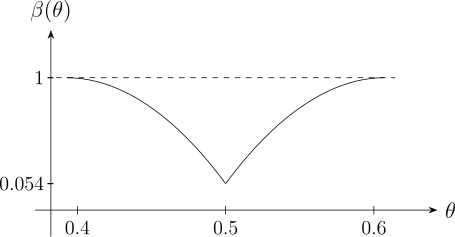
For this example, level of significance = 0.054.
Size of the test = 0.054 because \(H_0:\, \theta = \frac {1}{2}\,\) is a simple hypothesis. □
Questions on this section
Stuck on something here? Ask below and it stays attached to this topic.