4.10 Vector Functions and their Derivatives
We can study a particles motion in space by directing a vector from the origin to the particle as illustrated in the diagram.
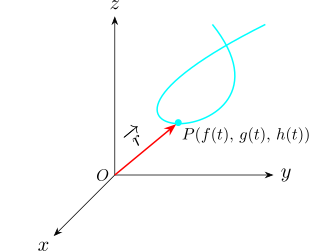
The particles movement during a time interval is thought of as the particles (coordinates which are functions of \(t\)) \[x = f(t) \hspace {0.2cm} , \hspace {0.2cm} y = g(t) \hspace {0.2cm} , \hspace {0.2cm} z = h(t)\] The points \((f(t), g(t), h(t))\) form a curve in space called the particle’s path. \[\overrightarrow {r}(t) = \overrightarrow {OP} = f(t) \textbf {i} + g(t) \textbf {j} + h(t) \textbf {k}\] gives the particle’s position at time \(t\) and is a vector function of the real variable \(t\).
Describe the curve defined by the vector function \(\overrightarrow {r}(t) = (2 + t)\textbf {i} + (3 - 4t)\textbf {j} + ( -1 -2t)\textbf {k}\)
Solution.
Note \(x = f(t) = 2 + t \hspace {0.2cm} , \hspace {0.2cm} y = g(t) = 3 - 4t \hspace {0.2cm} , \hspace {0.2cm} z = h(t) = -1 -2t\) which are the parametric equations of a line passing through \((2,3,-1)\) and parallel to the vector \(\overrightarrow {V} = \textbf {i} - 4\textbf {j} - 2\textbf {k}\).
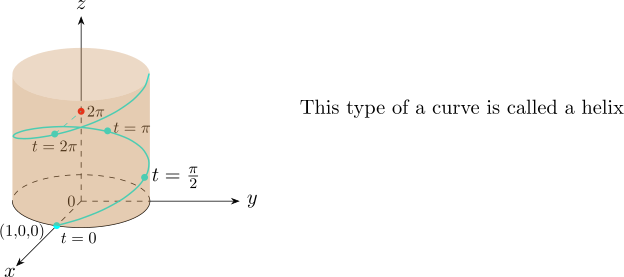
Give a sketch of the curve described by \(\overline {r}(t) = \cos (t) \textbf {i} + \sin (t) \textbf {j} + t\textbf {k}\)
Solution.
Note that \(x^2 + y^2 = \cos ^2 t + \sin ^2 t = 1\). The curve lies on a circular cylinder \(x^2 + y^2 = 1\).
Questions on this section
Stuck on something here? Ask below and it stays attached to this topic.