2.1 Tangents and Normals to General Plane Curves
Recall that if the function \(y = f(x)\) has a finite derivative for all \(x \in (a,b)\subset \mathbb {R}\) then \[\frac {dy}{dx} = f'(x)\] is called the gradient function. \(\dfrac {dy}{dx}\) given the gradient of the curve at every point \(x_0 \in (a,b)\). The derivative \(f'(x_0)\) is the gradient of the tangent to the curve \(y= f(x)\).
\(\therefore \) the equation of the tangent to the curve \(y = f(x)\) at \(x = x_0\) is given by \[\boxed {y - f(x_0) = f'(x_0)(x - x_0)}\]
Find the equations of the tangent with slope \(\dfrac {-2}{9}\) to the ellipse \(4x^2 + 9y^2 = 40\).
Solution.
Let \((x_0,y_0)\) be the point of the tangency of the required tangent. Then the point \((x_0,y_0)\) is on the ellipse \[\implies \hspace {0.5cm} 4x_0^2 + 9y_0^2 = 40\hspace {0.4cm} \cdots \cdots \cdots \hspace {0.4cm} (I)\] Also \(\displaystyle {\frac {dy}{dx} = \frac {-4x}{9y}}\) thus \(\displaystyle {\frac {-4x_0}{9y_0} = \frac {-2}{9}\implies y_0 = 2x_0}\)
Replacing \(y = 2x_0\) into \((I)\) we have
\[4x^2_0 + 36x^2_0 = 40 \implies x_0 = \pm 1 \implies y_0 = \pm 2\]
Thus the points of tangency are \((-1, -2)\) and \((1,2)\).
\(\therefore \) the required equations are \(y + 2 = \dfrac {-2}{9}(x + 1)\) and \(y - 2 = \dfrac {-2}{9}(x - 1)\).
The normal to the plane curve is the line that passes through the point and is perpendicular to the tangent of the curve at a point.
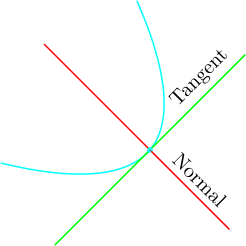
The gradient of the normal to the equation \(y = f(x)\) at \(x_0\) is \(\dfrac {-1}{f(x_0)}\). Therefore, the equation of the normal to the curve at \(x_0\) is given by \[\boxed {y - f(x_0) = \frac {-1}{f(x_0)} (x - x_0)}\]
Solution.
\(2x + 3y + 3x\dfrac {dy}{dx} + 2y\dfrac {dy}{dx} = 0\) \(\implies \hspace {0.5cm} \dfrac {dy}{dx} = \dfrac {-(2x + 3y)}{3x + 2y}\)
Thus, the gradient of the tangent at \((1,1)\) is \(-1\). Then gradient of the normal to the curve at \((1,1)\) is \(1\). There the equation of the normal to the curve at \((1,1)\) is \(y - 1 = (x - 1)\)
Questions on this section
Stuck on something here? Ask below and it stays attached to this topic.