2.4 Limits at Infinity
If \(f\) is the function defined by \(f(x) = \dfrac {1}{x}\) then
- 1.
- \(\lim \limits _{x\rightarrow +\infty } f(x) = 0\)
- 2.
- \(\lim \limits _{x\rightarrow -\infty } f(x) = 0\)
Note.
The notation \(x \longrightarrow +\infty \) is used if \(x\) increases without bound through positive integers values and the notation \(x \longrightarrow - \infty \) is used if \(x\) decreases without bound through negative values.
The graph of \(f(x) = \dfrac {1}{x}\) is as follows.
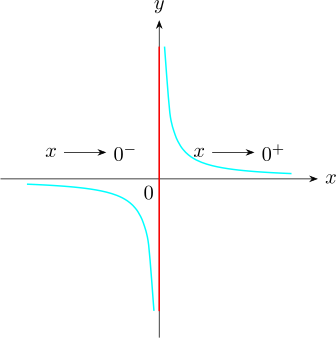
\[\lim \limits _{x\rightarrow 0^+} \dfrac {1}{x} = +\infty \hspace {0.5cm}, \hspace {0.5cm} \lim \limits _{x\rightarrow 0^-} \dfrac {1}{x} = -\infty \]
Evaluate \(\hspace {0.3cm}\lim \limits _{x\rightarrow +\infty } \dfrac {5x + 2}{3x - 7}\)
\begin {align*} \lim \limits _{x\rightarrow +\infty } \dfrac {5x + 2}{3x - 7} & = \lim \limits _{x\rightarrow +\infty } \dfrac {x\Bigl [5 + 2/x\Big ]}{x\Big [3 - 7/x\Big ]}\\ & = \frac {\lim \limits _{x\rightarrow +\infty }\Big [5 + 2 \Big (\dfrac {1}{x}\Big )\Big ]}{ \lim \limits _{x\rightarrow +\infty }\Big [3 - 7\Big (\dfrac {1}{x}\Big )\Big ]}\\ & = \dfrac {5}{3}\\ \end {align*}
Evaluate \(\lim \limits _{x\rightarrow +\infty } \dfrac {\sqrt [3]{x^3 + 1}}{5x - 2}\hspace {0.4cm},\hspace {0.4cm} x \neq \dfrac {2}{5}\)
Solution.
\(\lim \limits _{x\rightarrow +\infty } \dfrac {\sqrt [3]{x^3 + 1}}{5x - 2} = \dfrac {x \sqrt [3]{1 + \dfrac {1}{x^3}}}{x \Big [5 - 2\dfrac {1}{x}\Big ]}= \dfrac {1}{5}\)
Questions on this section
Stuck on something here? Ask below and it stays attached to this topic.