5 Differential Calculus of Functions of Several Variables
Most quantities of interest depend on more than one variable, and this section extends the derivative to that setting.
The extension is not automatic. With one variable there are only two directions of approach, so a limit either exists or does not; with two there are infinitely many paths to a point, and a function may behave well along every straight line and still fail to have a limit. Limits and continuity are therefore treated carefully before differentiation begins.
The partial derivative measures the rate of change in one variable with the others held fixed. From it come the chain rules, the total differential, and the linear approximation — the plane that best fits a surface near a point, which is the several-variable analogue of the tangent line and the basis of error estimation. The section closes with the location of maxima and minima, where the second derivative test acquires a genuinely new feature: a critical point may be a saddle, a maximum in one direction and a minimum in another, with no counterpart in one variable.
Functions of Several Variables
Suppose \(D\) is a collection of \(n-\)tuples of real numbers \((x_1,x_2,\cdots \cdots \cdots ,x_n)\). A real\(-\)valued function \(f\) with domain \(D\) is a rule that assigns a real number \(w = f(x_1,x_2,\cdots \cdots \cdots ,x_n)\) to each \(n-\)tuple of numbers in \(D\). The function’s range is the set of values the function takes on. The symbol \(w\) is the dependent variable of \(f\) and \(f\) is said to be a function on \(n\) independent variables \(x_1, x_2,\cdots \cdots \cdots , x_n\).
For example in the function \(V = \pi r^2 h\) the dependent variable is \(V\). The independent variables are \(r\) and \(h\).
Domains:
In defining functions of several variables we follow the usual practice of excluding inputs that lead to complex numbers or dividing by zero.
- 1.
- Sketch the domain of \(f(x,y) = \sqrt {y - x^2}\), what is the functions range?
- 2.
- What is the domain and range of \(\hspace {0.1cm} f(x,y) = \dfrac {xy}{x^2 - y^2}\).
Solution.
Part 1
\(\displaystyle {D_f = \{(x,y): y - x^2\geq 0\} = \{(x,y) : y \geq x^2\}}\)
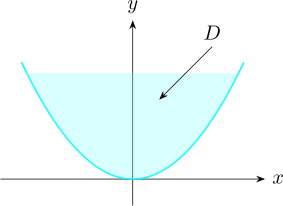
\(R_f = \{z \in \mathbb {R}: z\geq 0 \} = [0,\infty )\)
Part 2
\(D_f = \{(x,y): y \neq x\) and \(y\neq -x\}\)
\(R_f = \{z: -\infty < z < \infty \}\)
5.2 Limits and Continuity
5.3 Continuity
5.4 Partial Derivatives
5.5 The Chain Rule
5.5.1 The Chain Rule of Functions of Three Variations
5.6 Higher Order Derivatives
5.6.1 The mixed Derivative Theorem
5.6.2 The Implicit Function Theorem
5.7 Applications of Partial Derivatives
5.8 Maximum and Minimum Values
5.9 Tangent Planes
5.10 Linear Approximations
5.11 Predicting Change (Differentials)
5.12 Euler’s Theorem of Homogeneous Functions
5.13 Practice Problems
Questions on this section
Stuck on something here? Ask below and it stays attached to this topic.