2.18 The Circle of Curvature
The circle of curvature of a curve at a point \(P\) on it is the circle of radius \(P(\) radius of curvature\()\) lying on the concave side of the circle and tangent to it.
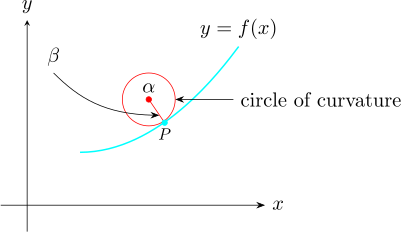
The centre of curvature for a point \(P(x,y)\) of a curve is the centre \(C\) of the circle of curvature at \(P\). The coordinates \((\alpha , \beta )\) of the centre of curvature are given by \[\alpha = x - \frac {\dfrac {dy}{dx}\Big [1 +\Big (\dfrac {dy}{dx}\Big )^2\Big ] }{\Big (\dfrac {d^2y}{dx^2}\Big )}\hspace {1cm}\text {and} \hspace {1cm} \beta = y+ \frac {1 + \Big (\dfrac {dy}{dx}\Big )^2}{\Big (\dfrac {d^2y}{dx^2}\Big )}\]
Find the equation of the circle of curvature of he curve \(\hspace {0.3cm} 2xy + x + y = 4\) at the point \(P(1,1)\).
Solution. \[(x - \alpha )^2 + (y - \beta )^2 = \rho ^2\] Differentiating we have \(\hspace {0.3cm}2y + 2xy' + 1 + y' = 0\)
At \(P(1,1)\hspace {0.2cm} , \hspace {0.4cm} y' = -1\hspace {0.2cm}\) and \(\hspace {0.2cm} (1 + y')^2 = 2\)
Differentiating again, we obtain \(\hspace {0.4cm} 2y' + 2y' + 2xy'' + y'' =0\)
\(\implies \hspace {0.4cm} 4y' + (2x + 1)y'' = 0\hspace {0.2cm}\) At \((1,1)\hspace {0.4cm} y'' = \dfrac {4}{3}\)
Thus \(\hspace {0.3cm} K = \dfrac {2}{3\sqrt {2}} \hspace {0.3cm} \implies \hspace {0.3cm} \rho = \dfrac {3\sqrt {2}}{2}\)
\[\text {And}\hspace {0.5cm} \alpha = x - \frac {y' (1 + y'^2)}{y''}= \frac {5}{2}\]
\[\beta = y + \frac {1 + y'^2}{y''} = \frac {5}{2}\]
\(\implies \hspace {0.5cm} \) the centre of curvature is \(\Big (\dfrac {5}{2},\dfrac {5}{2}\Big )\).
Therefore, the equation of the circle of curvature \[ \Big ( x - \frac {5}{2}\Big )^2 + \Big (y - \frac {5}{2}\Big )^2 = \frac {9}{2}\]
Questions on this section
Stuck on something here? Ask below and it stays attached to this topic.