11.2 Regression with competing risks
There are two regression models, answering different questions.
- The cause-specific Cox model fits a Cox model to \(h_k(t \mid x)\), treating failures from other causes as censored. This is legitimate, unlike the Kaplan–Meier estimate above, because the partial likelihood for \(h_k\) needs only the risk sets, and a subject who failed from another cause has left them. Its hazard ratios describe the effect of \(x\) on the rate of cause-\(k\) failure among those still event-free, the right target for questions about causes and mechanisms.
- The Fine–Gray model puts proportional hazards on the subdistribution hazard, \(\tilde h_k(t) = -\frac {\mathrm d}{\mathrm dt}\log \{1 - F_k(t)\}\), so that \(F_k(t \mid x) = 1 - \{1 - F_{k0}(t)\}^{\exp (\beta ^{\mathsf T}x)}\). Its risk set at \(t\) keeps subjects who have already failed from other causes, with weights that allow for censoring, and its coefficients describe the effect of \(x\) on the cumulative incidence itself, the right target for prediction and for questions such as “who is more likely to progress?”.
The two can differ in sign when \(x\) also affects the competing cause, and a full analysis reports the cause-specific models for every cause alongside the cumulative incidences.
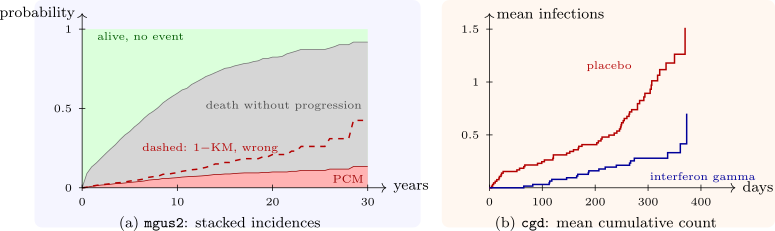
Example 11.2.1. For progression in mgus2, with age, sex and the size of the monoclonal protein spike (mspike, in g/dl), the cause-specific hazard ratios are \(1.017\) per year of age, \(0.995\) for men and \(2.42\) per g/dl, and the Fine–Gray subdistribution hazard ratios are \(0.983\), \(0.808\) and \(2.43\) (Software 11.5.2). The spike predicts progression whichever way it is measured. Age does not: among patients still alive and free of PCM, older patients progress at a slightly higher rate, but the cause-specific hazard of death rises by \(6.7\%\) per year of age, so older patients more often die first and have a lower cumulative incidence of progression. Both statements are true; they answer different questions. The same is true for sex, with men’s death hazard \(1.48\) times women’s.
Questions on this section
Stuck on something here? Ask below and it stays attached to this topic.