1.4 Independent Events, Conditional Probability and Bayes’ Theorem
1.4.1 Independent Events
Definition 1.4.1. Events \(A\) and \(B\) are said to be independent if and only if \(P(A\cap B)=P(A)P(B)\).
Theorem 1.4.3. If \(A\) and \(B\) are independent then the following are also independent
- (i).
- \(A\) and \(B'\)
Proof. We know that \(P(A\cap B)=P(A)P(B)\), since \(A\) and \(B\) are independent. \[A =(A\cap B')\cup (A\cap B)\] \[P(A) =P(A\cap B')+P(A\cap B)\] Therefore \begin {align*} P(A\cap B') &=P(A)-P(A\cap B)\\ &=P(A)-P(A)P(B)\\ &=P(A)(1-P(B))\\ &=P(A)P(B'). \end {align*}
i.e. \(P(A\cap B')=P(A)P(B')\) implies \(A\) and \(B'\) are independent. □
- (ii).
- \(A'\) and \(B\)
Proof. Write \(B =(A'\cap B)\cup (A\cap B)\), then \(P(B) = P(A'\cap B)+P(A\cap B)\) \begin {align*} P(A'\cap B) &=P(B)-P(A\cap B)\\ &=P(B)-P(A)P(B)\\ &=P(B)(1-P(A))\\ &=P(B)P(A'). \end {align*}
i.e. \(A'\) and \(B\) are independent. □
- (iii).
- \(A'\) and \(B'\)
Proof. Write \(A' = (A'\cap B)\cup (A'\cap B')\), then \[P(A') =P(A'\cap B)+P(A'\cap B')\] \begin {align*} P(A'\cap B') &=P(A')-P(A')P(B)\\ &=P(A')(1-P(B))\\ &=P(A')P(B'). \end {align*}
i.e. \(PA'\) and \(B'\) are independent. □
1.4.2 Conditional Probabilities
The probability properties discussed so far relate to the entire sample space. We have used the symbol \(P(A)\) and will continue to do so however we should have been more precise and used \(P(A/S)\) to read “ probability of \(A\) given the sample space \(S\)”.
The following definition justifies why \(P(A/S)\) is simply \(P(A)\) if \(S\) is the sample space.
Definition 1.4.4. Given a sample space \(S\), and events \(A\) and \(B\), then the conditional probability of \(A\) given \(B\) is denoted by \(P(A/B)\) and is given by \[P(A/B) = \begin {cases} \frac {P(A\cap B)}{P(B)} & \text {if}\hspace {0.2cm} P(B)>0\\\\ 0 &\text {if}\hspace {0.3cm} P(B)=0\\ \end {cases}\]
Theorem 1.4.5. If \(A\) and \(B\) are independent events, then \[P(A/B) =\frac {P(A\cap B)}{P(B)} = \frac {P(A)P(B)}{P(B)} = P(A).\]
Remark 1.4.6. We have \(P(A\cap B)=P(B)P(A/B)\) this is known as multiplicative rule of probability.
Definition 1.4.7. If \(B_1, B_2, \ldots , B_k\) are mutually exclusive events of the sample space \(S\) and if \[\bigcup \limits ^k_{j=1}B_j=S,\] then \(B_1, B_2, \ldots , B_k\) are said to be a partition of the sample space \(S\).
Theorem 1.4.8 (Total Probability). If \(B_1, B_2,\cdots B_k\) is a partition of the sample space \(S\) and \(A\) is an arbitrary event on \(S\) then the probability of \(A\) is given by \begin {align*} P(A) &=\sum ^k_{j=1}P(B_j)P(A/B_j)\\ &=P(B_1)P(A/B_1) +P(B_2)P(A/B_2)+ \cdots +P(B_k)P(A/B_k). \end {align*}
Proof. Let \(S\) be a sample space and \(A\) be an event in \(S\). Then for a partition \(B_1, B_2, \ldots , B_k\) of \(S\). We have \[A = (A\cap B_1)\cup (A\cap B_2)\cup (A\cap B_3)\cup \cdots \cup (A\cap B_k) =\bigcup ^k_{j=1}(A\cap B_j)\] Therefore \[P(A) =\sum ^k_{j=1}P(A\cap B_j) =\sum ^k_{j=1}P(B_j)P(A/B_j).\] □
1.4.3 Bayes theorem
There are many situations where the ultimate outcome of an experiment depends on what happens in various intermediate stages. This issue is resolved by the Bayes’ Theorem.
Definition 1.4.9 (Bayes theorem). If \(B_1, B_2, \ldots , B_k\) is a partition of the sample space \(S\) and \(A\) is an arbitrary event on \(S\), then \[P(B_r/A)=\frac {P(B_r)P(A/B_r)}{\sum \limits _{j=1}^kP(B_j)P(A/B_j)}\, , \quad r = 1, 2, \ldots , k.\]
Proof. From the definitions of conditional probability and total probability, we obtain \[P(B_r/A) =\frac {P(B_r\cap A)}{P(A)} = \frac {P(B_r)P(A/B_r)}{\sum \limits ^k_{j=1}P(B_j)P(A/B_j)}.\] □
Note 1.4.10. In the Bayes Theorem, the probability \(P(B_j)\) is called prior probability. The Probability \(P(B_j/A)\) is called posterior probability.
Example 1.4.11. In a factory for manufacturing of car batteries, machines \(A\), \(B\) and \(C\) manufacture respectively \(25\%\), \(35\%\) and \(40\%\) of the total produce. The Percentage of defective batteries from machine \(A\), \(B\) and \(C\) are 5, 4 and 2 respectively.
- (i).
- A car battery is selected at random. What is the probability that it is defective?
Solution. Machines are the partitions: \(A\), \(B\), \(C\). Let \(D\) represent the battery is defective. Given \[P(A)=0.25,\quad \quad P(B)=0.35,\quad \quad P(C)=0.40,\] \[P(D/A)=0.05, \quad P(D/B)=0.04, \quad P(D/C)=0.02\] Then \begin {align*} P(D) & = P(A)\,P(D/A)+P(B)\, P(D/B)+P(C)\, P(D/C)\\ &= 0.25\times 0.05 + 0.35\times 0.04 + 0.40\times 0.02\\ &=0.0125+0.014+0.008\\ &=0.0345 \end {align*} □
- (ii).
- A car battery is selected at random and found to be defective. What is the probability that it
was manufactured by machine \(B\)?
Solution. \begin {align*} P(B/D) &=\frac {P(B)P(D/B)}{P(D)}\\ &=\frac {(0.35\times 0.04)}{0.0345}\\ &=\frac {0.0140}{0.0345}\\ &=\frac {28}{69} \end {align*} □
- (iii).
- Battery is selected at random and found to be non-defective. What is the probability that it
was manufactured by machine \(A\)?
Solution. You can use the tree diagram to find \(P(D')\)
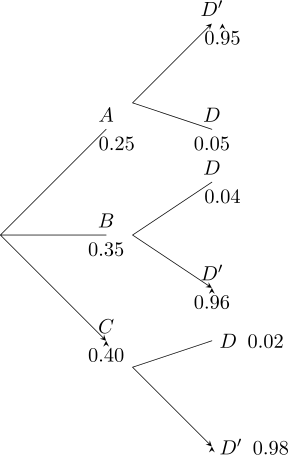
Or you can use the fact that \(P(D') = 1- P(D)\). \begin {align*} P(A/D') & = \frac {P(A)\, P(D'/A)}{P(D')}\\ & = \frac {0.25\times 0.95}{1 - 0.0345}\\ & = \frac {475}{1931}\\ & =0.246 \end {align*} □
1.4.4 Contingency Tables
A Contingency Table is a tabular method used to classify sample observations according to two or more identifiable categories. In the case of two variables, the table rows represent the levels of one variable, and the columns represent the levels of the other. The intersections (cells) represent the joint probability of those specific events occurring simultaneously.
Purpose of Contingency Tables:
- 1.
- To organise complex joint event data into a readable format.
- 2.
- The row and column totals (margins) provide the probabilities of a single event occurring, regardless of the other variable.
- 3.
- They provide the raw data necessary to determine if two categorical variables are associated.
Example 1.4.12. To investigate the relationship between smoking and health outcomes, let \(A\) be the event that an individual smokes (\(A^c\) for non-smokers) and \(D\) be the event that an individual develops lung cancer (\(D^c\) for no cancer). If the probability that
- (i).
- an individual smokes and develops lung cancer is 0.15.
- (ii).
- an individual smoke and doesn’t develops lung cancer is 0.25.
- (iii).
- an individual doesn’t smoke and develops lung cancer is 0.10.
- (iv).
- and individual doesn’t smoke and doesn’t develop lung cancer is 0.50.
How can this information be used to examine, the relationship between smoking and lung cancer?
Solution. We are given the following joint probabilities: \[P(A \cap D) = 0.15,\quad P(A \cap D^c) = 0.25,\quad P(A^c \cap D) = 0.10,\quad P(A^c \cap D^c) = 0.50\]
Step 1: Construct the probability table.
By summing the rows and columns, we obtain the marginal probabilities \(P(A)\) and \(P(D)\).
| Smoking Status | Cancer (\(D\)) | No Cancer (\(D^c\)) | Marginal Totals |
| Smoker (\(A\)) | \(0.15\) | \(0.25\) | \(P(A) = 0.40\) |
| Non-Smoker (\(A^c\)) | \(0.10\) | \(0.50\) | \(P(A^c) = 0.60\) |
| Marginal Totals | \(P(D) = 0.25\) | \(P(D^c) = 0.75\) | \(\mathbf {1.00}\) |
Step 2: Comparative Analysis (Relative Risk)
To see how smoking affects cancer risk, we compare the conditional probabilities:
Risk for Smokers \[P(D|A) = \frac {P(A \cap D)}{P(A)} = \frac {0.15}{0.40} = 0.375\] Risk for Non-Smokers \[P(D|A^c) = \frac {P(A^c \cap D)}{P(A^c)} = \frac {0.10}{0.60} \approx 0.167\] The Relative Risk (RR): \[ RR = \frac {P(D|A)}{P(D|A^c)} = \frac {0.375}{0.1667} = 2.25 \] An individual who smokes is 2.25 times more likely to develop lung cancer than a non-smoker.
Step 3: The Odds Ratio (OR)
In epidemiology, we often use the Odds Ratio (or Cross-Product Ratio) to estimate the strength of association. For a table with cells \(a, b, c, d\): \[ OR = \frac {a \times d}{b \times c} = \frac {0.15 \times 0.50}{0.25 \times 0.10} = \frac {0.075}{0.025} = 3 \]
While the Relative Risk (2.25) tells us how much the probability increases, the Odds Ratio (3.0) provides a different mathematical perspective on the strength of the link. Since \(OR \neq 1\), we can conclude that smoking and lung cancer are not independent events. □
1.4.5 Practice Problems
Past tutorial-sheet questions on conditional probability, independence and Bayes’ theorem. Try each one before opening the solution.
Problem 1.4.1. A manufacturer of airplane parts knows from experience that the probability is \(0.80\) that an order will be ready for shipment on time, and \(0.72\) that an order will be ready for shipment on time and will also be delivered on time. What is the probability that such an order will be delivered on time given that it was ready for shipment on time?
Show solution
Solution. Let \(R\) be the event that the order is ready on time and \(D\) that it is delivered on time. We are given \(P(R)=0.80\) and \(P(R\cap D)=0.72\). By the definition of conditional probability, \[P(D/R) = \frac {P(R\cap D)}{P(R)} = \frac {0.72}{0.80} = 0.9.\]
Problem 1.4.2. If we randomly pick two television sets in succession from a shipment of 240 television sets of which 15 are defective, what is the probability that they will both be defective?
Show solution
Solution. The sets are picked in succession without replacement, so the second probability is conditional on the first. Let \(D_1\) and \(D_2\) be the events that the first and second set are defective. \[P(D_1\cap D_2) = P(D_1)\,P(D_2/D_1) = \frac {15}{240}\times \frac {14}{239} = \frac {7}{1912} \approx 0.0037.\] After one defective set is removed, 14 of the remaining 239 are defective – that is what makes the second factor \(\tfrac {14}{239}\) and not \(\tfrac {15}{240}\).
Problem 1.4.3. Two events \(A\) and \(B\) are such that \(P(A)=\frac {1}{4}\), \(P(A/B)=\frac {1}{2}\) and \(P(B/A)=\frac {2}{3}\).
- (a).
- Are \(A\) and \(B\) independent events?
- (b).
- Find \(P(A\cap B)\).
- (c).
- Are \(A\) and \(B\) mutually exclusive events?
- (d).
- Find \(P(B)\).
- (e).
- Find \(P(A\cup B)\).
Show solution
Solution. It is easiest to find \(P(A\cap B)\) first and answer the rest from it.
(b). From \(P(B/A)=\frac {P(A\cap B)}{P(A)}\), \[P(A\cap B) = P(B/A)\,P(A) = \frac {2}{3}\times \frac {1}{4} = \frac {1}{6}.\]
(a). \(A\) and \(B\) are independent only if \(P(A/B)=P(A)\). Here \(P(A/B)=\tfrac 12\) but \(P(A)=\tfrac 14\), so they are not independent. (Equivalently \(P(A)P(B)=\tfrac 14\times \tfrac 13=\tfrac 1{12}\neq \tfrac 16=P(A\cap B)\).)
(c). Mutually exclusive would mean \(P(A\cap B)=0\). Here \(P(A\cap B)=\tfrac 16\neq 0\), so they are not mutually exclusive.
(d). From \(P(A/B)=\frac {P(A\cap B)}{P(B)}\), \[P(B) = \frac {P(A\cap B)}{P(A/B)} = \frac {1/6}{1/2} = \frac {1}{3}.\]
(e). By the addition rule, \[P(A\cup B) = P(A)+P(B)-P(A\cap B) = \frac {1}{4}+\frac {1}{3}-\frac {1}{6} = \frac {5}{12}.\]
Problem 1.4.4. Events \(A\) and \(B\) are such that \(P(A)=\frac {2}{5}\) and \(P(B)=\frac {1}{4}\).
- (a).
- If \(A\) and \(B\) are independent events, find (i) \(P(A\cap B)\), (ii) \(P(A\cap B')\), (iii) \(P(A\cup B)\).
- (b).
- If \(A\) and \(B\) are mutually exclusive, find (i) \(P(A\cup B)\), (ii) \(P(A'\cap B)\).
Show solution
Solution. (a). Independence gives \(P(A\cap B)=P(A)P(B)\), and \(A\) is then also independent of \(B'\). \begin {align*} \text {(i)}\quad P(A\cap B) &= \frac {2}{5}\times \frac {1}{4} = \frac {1}{10}.\\ \text {(ii)}\quad P(A\cap B') &= P(A)\,P(B') = \frac {2}{5}\times \frac {3}{4} = \frac {3}{10}.\\ \text {(iii)}\quad P(A\cup B) &= \frac {2}{5}+\frac {1}{4}-\frac {1}{10} = \frac {11}{20}. \end {align*}
(b). Mutually exclusive means \(A\cap B=\emptyset \), so \(P(A\cap B)=0\). \begin {align*} \text {(i)}\quad P(A\cup B) &= P(A)+P(B) = \frac {2}{5}+\frac {1}{4} = \frac {13}{20}.\\ \text {(ii)}\quad P(A'\cap B) &= P(B)-P(A\cap B) = \frac {1}{4}-0 = \frac {1}{4}. \end {align*}
Note that the two parts describe different situations: events cannot in general be both independent and mutually exclusive.
Problem 1.4.5. Events \(A\) and \(B\) are such that \(P(A)=\frac {4}{7}\), \(P(A\cap B')=\frac {1}{3}\) and \(P(A/B)=\frac {5}{14}\). Find
- (a).
- \(P(A\cap B)\);
- (b).
- \(P(B)\);
- (c).
- \(P(B/A)\).
Show solution
Solution. (a). The events \(A\cap B\) and \(A\cap B'\) partition \(A\), so \[P(A\cap B) = P(A)-P(A\cap B') = \frac {4}{7}-\frac {1}{3} = \frac {12}{21}-\frac {7}{21} = \frac {5}{21}.\]
(b). From \(P(A/B)=\frac {P(A\cap B)}{P(B)}\), \[P(B) = \frac {P(A\cap B)}{P(A/B)} = \frac {5/21}{5/14} = \frac {5}{21}\times \frac {14}{5} = \frac {2}{3}.\]
(c). \[P(B/A) = \frac {P(A\cap B)}{P(A)} = \frac {5/21}{4/7} = \frac {5}{21}\times \frac {7}{4} = \frac {5}{12}.\]
Problem 1.4.6. A box contains 4 black, 6 white and 2 red balls. Balls are picked out of the box without replacement. Find the probability that
- (a).
- the first ball picked is black and the second one is white;
- (b).
- the second ball picked is white;
- (c).
- the first ball picked is black, the second is white and the third is red;
- (d).
- the first three balls picked are of different colours.
Show solution
Solution. There are \(4+6+2=12\) balls, and each pick removes one.
(a). \[P(B_1\cap W_2) = \frac {4}{12}\times \frac {6}{11} = \frac {24}{132} = \frac {2}{11}.\]
(b). The second ball can be white either after a white first ball or after a non-white one: \[P(W_2) = \frac {6}{12}\cdot \frac {5}{11} + \frac {6}{12}\cdot \frac {6}{11} = \frac {30+36}{132} = \frac {66}{132} = \frac {1}{2}.\] This is just \(\tfrac {6}{12}\), the same as \(P(W_1)\) – and that is no accident. Before any ball is seen, the second position is as likely to hold any particular ball as the first is, so drawing without replacement does not favour one position over another.
(c). \[P(B_1\cap W_2\cap R_3) = \frac {4}{12}\times \frac {6}{11}\times \frac {2}{10} = \frac {48}{1320} = \frac {2}{55}.\]
(d). Three different colours means one black, one white and one red in some order. Each particular order has the same probability \(\tfrac {48}{1320}\) as in (c), and there are \(3!=6\) orders, so \[P = 6\times \frac {48}{1320} = \frac {288}{1320} = \frac {12}{55}.\]
Problem 1.4.7. The members of a consulting firm rent cars from three rental agencies: 60 percent from agency 1, 30 percent from agency 2, and 10 percent from agency 3. If 9 percent of the cars from agency 1 need an oil change, 20 percent of the cars from agency 2 need an oil change, and 6 percent of the cars from agency 3 need an oil change, what is the probability that a rental car delivered to the firm will need an oil change?
Show solution
Solution. The three agencies partition the sample space, so this is the law of total probability. Let \(A_1, A_2, A_3\) be the agencies and \(C\) the event that the car needs an oil change. \begin {align*} P(C) &= P(A_1)P(C/A_1)+P(A_2)P(C/A_2)+P(A_3)P(C/A_3)\\ &= (0.60)(0.09)+(0.30)(0.20)+(0.10)(0.06)\\ &= 0.054+0.060+0.006 = 0.12. \end {align*}
Problem 1.4.8. A rare but serious disease, \(D\), has been found in \(0.01\) percent of a certain population. A test has been developed that will be positive, \(p\), for 98 percent of those who have the disease and be positive for only 3 percent of those who do not have the disease. Find the probability that a person who tests positive does not have the disease.
Show solution
Solution. Note that \(0.01\) percent means \(P(D)=0.0001\), so \(P(D')=0.9999\). We are given \(P(p/D)=0.98\) and \(P(p/D')=0.03\). By the law of total probability, \begin {align*} P(p) &= P(D)P(p/D)+P(D')P(p/D')\\ &= (0.0001)(0.98)+(0.9999)(0.03)\\ &= 0.000098+0.029997 = 0.030095. \end {align*}
Then by Bayes’ theorem, \[P(D'/p) = \frac {P(D')P(p/D')}{P(p)} = \frac {0.029997}{0.030095} \approx 0.9967.\] Almost every positive result is a false alarm. This is not a fault in the test – it is what happens when a disease is rare: the 3% of a very large healthy group vastly outnumbers the 98% of a very small sick one.
Problem 1.4.9. A random sample of 200 adults is classified below according to sex and the level of education attained.
| Education | Male | Female | Total |
| Primary | 38 | 45 | 83 |
| Secondary | 28 | 50 | 78 |
| College | 22 | 17 | 39 |
| Total | 88 | 112 | 200 |
If a person is picked at random from the group, find the probability that the person is
- (a).
- a female;
- (b).
- a male, given that the person has secondary education;
- (c).
- not a college graduate, given that the person is a female.
Show solution
Solution. (a). There are \(45+50+17 = 112\) females out of 200: \[P(F) = \frac {112}{200} = \frac {14}{25} = 0.56.\]
(b). Conditioning on secondary education restricts attention to that row, which has \(28+50=78\) people, of whom 28 are male: \[P(M/S) = \frac {28}{78} = \frac {14}{39} \approx 0.359.\]
(c). Conditioning on female restricts attention to that column, which has 112 people, of whom \(45+50=95\) are not college graduates: \[P(C'/F) = \frac {95}{112} \approx 0.848.\]
Problem 1.4.10. A large industrial firm uses 3 local motels to provide overnight accommodation for its clients. From past experience it is known that 20% of the clients are assigned rooms at the Ramada Inn, 50% at the Sheraton, and 30% at the Lakeview Lodge. If the plumbing is faulty in 5% of the rooms at the Ramada Inn, in 4% of the rooms at the Sheraton, and in 8% of the rooms at the Lakeview Lodge, what is the probability that
- (a).
- a client will be assigned a room with faulty plumbing?
- (b).
- a person with a room having faulty plumbing was assigned accommodation at the Lakeview Lodge?
Show solution
Solution. Let \(R\), \(S\) and \(L\) be the three motels and \(F\) the event of faulty plumbing.
(a). The three motels partition the clients, so by the law of total probability \begin {align*} P(F) &= P(R)P(F/R)+P(S)P(F/S)+P(L)P(F/L)\\ &= (0.20)(0.05)+(0.50)(0.04)+(0.30)(0.08)\\ &= 0.010+0.020+0.024 = 0.054. \end {align*}
(b). This reverses the conditioning, so it is Bayes’ theorem: \[P(L/F) = \frac {P(L)P(F/L)}{P(F)} = \frac {0.024}{0.054} = \frac {4}{9} \approx 0.444.\] The Lakeview Lodge takes only 30% of the clients but accounts for 44% of the complaints, because its rooms are the worst.
Problem 1.4.11. Three members of a private club have been nominated for the office of president. The three members are Mr Tembo, Mr Chela and Mr Haziyu, and their probabilities of being elected are \(0.3\), \(0.4\) and \(0.3\) respectively. Should Mr Tembo be elected, the probability of an increase in membership fees is \(0.6\); should Mr Chela or Mr Haziyu be elected, the corresponding probabilities are \(0.2\) and \(0.4\).
- (a).
- What is the probability that there will be an increase in membership fees?
- (b).
- Someone considering joining the club delays the decision for several weeks, only to find that the fees have been increased. What is the probability that Mr Chela was elected president?
Show solution
Solution. Let \(T\), \(C\) and \(H\) be the events that each man is elected, and \(I\) the event of an increase in fees. Exactly one of the three is elected, so they partition the sample space – note \(0.3+0.4+0.3 = 1\).
(a). By the law of total probability, \begin {align*} P(I) &= P(T)P(I/T)+P(C)P(I/C)+P(H)P(I/H)\\ &= (0.3)(0.6)+(0.4)(0.2)+(0.3)(0.4)\\ &= 0.18+0.08+0.12 = 0.38. \end {align*}
(b). The fee increase is known and the election is what we are asking about, so the conditioning is reversed and this is Bayes’ theorem: \[P(C/I) = \frac {P(C)P(I/C)}{P(I)} = \frac {0.08}{0.38} = \frac {4}{19} \approx 0.211.\] Mr Chela was the most likely to be elected, at \(0.4\), yet learning that the fees went up makes him the least likely of the three to have won – he was the candidate least inclined to raise them.
Problem 1.4.12. Psychologists tend to believe that there is a relationship between aggressiveness and order of birth. The percentages of students falling into the four categories are:
| Aggressiveness | First born | Not first born |
| Aggressive | 25% | 20% |
| Not aggressive | 15% | 40% |
A student is chosen at random.
- (a).
- What is the probability that the student is (i) first born, (ii) aggressive, (iii) aggressive given that the student was first born?
- (b).
- If \(A\) is the event that a student is aggressive and \(B\) that a student is first born, are \(A\) and \(B\) independent? Explain.
- (c).
- What can you say about the psychologists’ belief?
Show solution
Solution. The four cells are the joint probabilities and they sum to \(1\).
(a). Summing the first-born column and the aggressive row, \begin {align*} \text {(i)}\quad P(B) &= 0.25+0.15 = 0.40,\\ \text {(ii)}\quad P(A) &= 0.25+0.20 = 0.45,\\ \text {(iii)}\quad P(A/B) &= \frac {P(A\cap B)}{P(B)} = \frac {0.25}{0.40} = 0.625. \end {align*}
(b). Independence would require \(P(A\cap B) = P(A)P(B)\). Here \[P(A)P(B) = (0.45)(0.40) = 0.18, \qquad \text {but}\qquad P(A\cap B) = 0.25.\] These differ, so \(A\) and \(B\) are not independent. Equivalently, \(P(A/B)=0.625\) is not equal to \(P(A)=0.45\): knowing a student is first born changes the probability that they are aggressive.
(c). In these data the psychologists’ belief is supported. A first born is aggressive with probability \(0.625\), against \(0.45\) for a student chosen without regard to birth order, so the two characteristics are associated.
Association is not causation, though, and it is worth being careful here: these figures show only that aggressiveness and birth order occur together more often than chance would produce. They say nothing about which, if either, brings about the other.
Problem 1.4.13. A sociologist wants to estimate the percentage of students who have smoked cannabis. One hundred students are randomly selected. To allay any fears about confidentiality the question is asked indirectly: each student first picks a number at random between \(00\) and \(99\) without revealing it. Anyone whose number is between \(00\) and \(69\) answers the cannabis question; the others answer the non-sensitive question “does your computer number end with an even digit?”. Each student writes only the answer on a slip of paper, without indicating which question it belongs to. It turns out that \(44\%\) of the responses are “yes”. What fraction would you estimate to be answering “yes” to the cannabis question?
Show solution
Solution. The design is deliberate: because nobody knows which question a slip refers to, no individual answer reveals anything – yet the aggregate is still informative, because the two questions are mixed in known proportions.
Of the hundred numbers \(00\) to \(99\), seventy fall in \(00\)–\(69\), so a student answers the cannabis question with probability \(0.7\) and the computer-number question with probability \(0.3\). A computer number is as likely to end in an even digit as an odd one, so the non-sensitive question yields “yes” with probability \(0.5\).
Let \(p\) be the proportion who would answer “yes” to the cannabis question. By the law of total probability, \[P(\text {yes}) = 0.7p + 0.3(0.5) = 0.7p + 0.15.\] Setting this equal to the observed \(0.44\), \[0.7p = 0.44-0.15 = 0.29 \implies p = \frac {0.29}{0.7} = \frac {29}{70} \approx 0.414.\] So an estimated \(41.4\%\) of students have smoked cannabis.
Note what the randomisation costs. The \(0.3\) of responses answering the harmless question carry no information about cannabis at all, so the estimate rests on fewer usable answers than the hundred collected – the price paid for honest ones.
Questions on this section
Stuck on something here? Ask below and it stays attached to this topic.