11.1 Fixed and random factors
Definition 11.1.1. A factor is fixed if its levels are chosen deliberately and inference concerns those levels only. It is random if its levels are a random sample from a population of possible levels and inference concerns the population. A model whose factors are all fixed is a fixed effects model, one whose factors are all random is a random effects model (or variance components model), and one with both kinds is a mixed model.
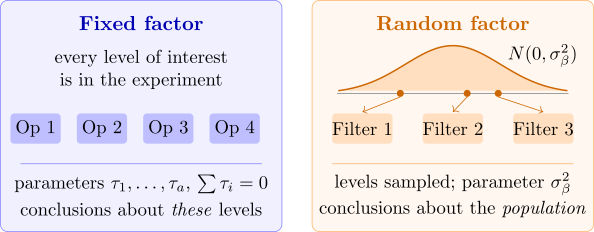
The difference is in the question asked, not the arithmetic. In a fixed effects model the effects \(\tau _1, \dots , \tau _t\) are unknown constants with \(\sum \tau _i = 0\), the hypothesis is \(\tau _1 = \dots = \tau _t = 0\), and the conclusions apply only to the \(t\) levels studied; a repeat of the experiment would use the same levels. In a random effects model the effects are independent draws from a distribution, usually \(N(0, \sigma ^2_\tau )\), the hypothesis is \(\sigma ^2_\tau = 0\), and the conclusions apply to every level in the population, including the ones not in the experiment; a repeat would draw new levels (Figure 12). Two practical tests help to decide: would a repeat of the experiment use the same levels? and does anyone care about the effect of a particular level? If the answers are no, the factor is random.
Questions on this section
Stuck on something here? Ask below and it stays attached to this topic.