2.2 Quotient Groups
Definition 2.2.1. Let \((G\, , \, *)\) and \((H\, , \,\cdot )\) be groups (where \(*\, ,\, \cdot \,\) are the respective operations in \(G\) and \(H\)). Then the function \(f:\, G\longrightarrow H\) is a homomorphism if; \(\, f(a*b) = f(a)\cdot f(b)\,\,\,\, \forall a\, , \, b\in G\).
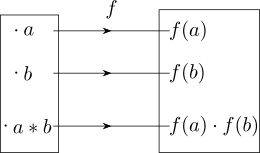
Note. In the case where \(f\) is a bijection, then we say it is an Isomorphism
Example 1
- 1.
- Let \(G(\mathbb {R}\, ,\, +)\, , \,\, H = (\mathbb {R}\, ,\, X)\). Consider \(f(x) = e^x\). Show that \(f\) is a homorphism.
Solution. Let \(a\, , \, b\in (\mathbb {R}\, , \, +)\). Then \(\, f(a + b) = e^{a+b} = e^a\cdot e^b = f(a)\cdot f(b)\).
- 2.
- Let \(A\, , \, B\) be groups, consider \(\, \pi :\, A\times B \longrightarrow A\) divided by \(\pi (a,b) = a\), where \(a\in A\, , \, b\in B\). \(\pi \) is a homorphism. Since for \((a,b)\, ,\, (a',b')\in A\times B\) for the direct product.
We know that we can apply it pairwise as
\[\pi \big [(a,b)(a',b')\big ] = \pi (aa',bb') = aa' = \pi (a,b)\, \pi (a',b')\]
If we use addition, we have \(\, \pi (a+a'\, , \, b+ b')\).
Questions on this section
Stuck on something here? Ask below and it stays attached to this topic.