2.3 Some Fundamental Properties of Homomorphisms
Let \(Q:\, G\longrightarrow H\) be a homomorphism. Then the following are always true.
- •
- \(Q\big (e_G\big ) = e_H\) (identity in \(G\) should be sent to the identity in \(H\)).
- •
- \(Q\big (g^{-1}\big ) = \big (Q(g)\big )^{-1}\), where \(g^{-1}\in G\, , \, Q(g)\in H\).
- •
- \(Q\big (g^k\big ) = \big (Q(g)\big )^k,\) where \(g^k\in G\, ,\, Q(g)\in H\).
- •
- \(Q(g)\) is a subgroup of \(H\).
- •
- If \(Q\) one-to-one, then \(G\approx Q(G)\). \((\approx \) Isomorphic to \(Q(G))\). In this case, we say the subgroup \(Q(G)\) is a homomorphic
image of the group \(G\).
Definition 2.3.1. Let \(\, Q:\, G\longrightarrow H\) be a homomorphism, then the kernel of \(Q\) denoted
\(ker\, Q \, \cong \, \{g\in G:\, Q(g) = e_N\}\). Just like in vector space, all there elements sent to identity zero “0” are Kernel(s).
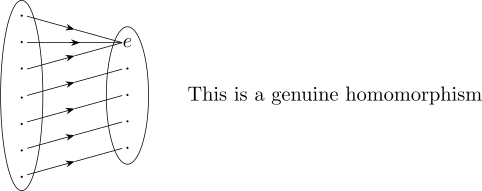
Theorem 2.3.2. Let \(Q :\, G\longrightarrow H\,\) be a homomorphism, then \(ker\, Q\) is a subgroup of \(G\).
Proof. \(ker\, Q = \phi \) since \(Q(e_G) = eH \implies e_G\in \, ker\, Q\). Let \(g\, , \, h\in \, ker\, Q\), we check if \(gh^{-1}\in \, ker\, Q\). \begin {align*} Q\big (gh^{-1}\big ) & = Q(g)\, Q\big (h^{-1}\big ) = Q(g)\, \big (Q(h)\big )^{-1}\\ & = e_H\cdot \big (e_H\big )^{-1}\\ & = e_H \end {align*}
\(\therefore \, gh^{-1}\in \, ker\, Q\) and that it is a subgroup of \(G\).
□
Exercise 2.3.3. Prove that \(\,ker\, Q\,\underline {\Delta }\, G\, \) (\(\underline {\Delta }\) means normal on).
Proof. Let \(G\) be a group and \(ker \, Q\) be a subgroup of \(G\) such that \(\forall \, x\in G\) and \(Q(x) = e_H\), then \(x\in ker\, Q\). Let \(g\in G\) and \(x\in ker\, Q\), then \begin {align*} Q(xg) & = Q(x)\, Q(g) = e_H\,Q(g) = Q(g) e_H\\ & = Q(g)\, Q(x)\\ & = Q(gx) \end {align*}
So that \(\, Q^{-1}Q(xg) = Q^{-1}Q(gx) \implies xg = gx \hspace {0.3cm} \forall g\in G\). Implying \(gxg^{-1} = x\in ker\, Q\, \implies gxg^{-1}\in ker\, Q\). Thus \(\, ker\, Q\, \underline {\Delta }\, G\).
□
Example 2.3.4. Let \(\, Q:\, \mathbb {Z}\longrightarrow \mathbb {Z}_n\,\) defined as follow. \(\,Q(a + b) = [a] + [b] = Q(a) + Q(b)\)
e.g if we have \(\mathbb {Z}_4\) split \([1][2][3][4]\) \begin {align*} Z\longrightarrow \mathbb {Z}_4\hspace {2cm} 1 & = [1] = \{1,\, 5,\, 9,\, 13,\, 17,\, \cdots \cdots \}\hspace {0.5cm}\text {what it does is}\hspace {0.2cm}\mathbb {Z}_4\hspace {0.2cm}\text {split}\hspace {0.2cm}\mathbb {Z}\hspace {0.2cm}\text {into 4 graphs}\\ 2 & = [2] = \{2, \, 6,\, 10,\, 14,\, \cdots \cdots \}\\ 3 & = [3] = \{3,\, 7,\, 11,\, 15,\, \cdots \cdots \}\\ 0 & = [0] = \{0,\, 4,\, 8,\, 12,\, 16,\, \cdots \cdots \} \end {align*}
So, if we pick \((1 + 2) = 3\) which is in the next, so \(\, ker\, Q = 0\in [0]\)
\[5 + 6 = 1\]
Clearly, \(Q\) is onto but not one-to-one.
What is \(ker\, Q\), so we are looking for those elements in \(Q(a + b)\) which will be sent to identity.
Note that for \(\mathbb {Z}\longrightarrow \mathbb {Z}_n\) are \(c = 0 = [0]\).
What is \(\, ker\, Q\)?
The kernel of \(Q\) consist of all multiples of \(n\) since \(Q(kn) = Q(k)\,Q(n) = Q(k)\cdot 0 = 0\) (since \(Q(n) = 0\) which is the identity of \(\mathbb {Z}_n\)).
\(\bullet \) For \(\pi :\, A\times B \longrightarrow A\), find \(\, ker\, \pi \). By definition
\[\pi (a,b)\longrightarrow a\]
\[\implies \, e(A,b) = e_A\]
We have \(\, ker\, \pi = \big \{(e_A\, , \, b)\big |,\, e_A\) is identity for \(A\, , b\in B\big \}\) because by definition \(\, \pi (e_A\, , \, b) = e_A\).
Theorem 2.3.5. In the case where \(Q:\, G\longrightarrow H\,\) is an isomorphism, then \(\, ker\, Q = \{e_G\}\)
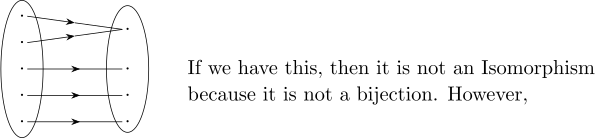
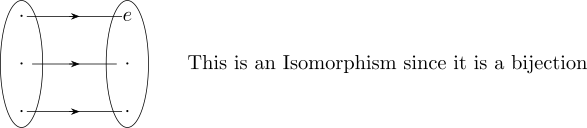
Proof. An isomorphism is injective. If \(g\in \ker Q\) then \(Q(g) = e_H = Q(e_G)\), and injectivity forces \(g = e_G\). Conversely \(e_G\) always lies in the kernel. Hence \(\ker Q = \{e_G\}\). □
Note. The converse holds too and is the more useful direction: a homomorphism is injective if and only if its kernel is trivial. Checking one element is easier than checking every pair, which is why kernels are the standard tool for proving injectivity.
Note. If you want to prove or see if it is an isomorphism start with a homomorphism then if
it is a bijection (one-to-one) then it is an isomorphism.
Exercise 2.3.6. Let \(\, Q:\, G\longrightarrow H\). Suppose the \(\, ker\, Q = \{e_G\}\), show that \(Q\) is a bijection.
Proposition *
Let \(H\) and \(K\) be subgroups of a group \(G\)
- (i)
- If one of the subgroups \(H\) or \(K\) is a normal subgroup, then \(HK\) is a subgroup of \(G\).
- (ii)
- If both \(H\) and \(K\) are normal, then \(HK\) is normal in \(G\).
Theorem 2.3.7 (Properties of Subgroups Under Homomorphism). Let \(\, \phi :\, G\longrightarrow G'\,\) be a homomorphism and \(H<G\), then
- 1.
- \(\phi (H)\) is a subgroup of \(G'\).
- 2.
- If \(H\) is Cyclic, then \(\phi (H)\) is Cyclic.
- 3.
- If \(H\) is Abelian, then \(\phi (H)\) is abelian.
- 4.
- If \(H\, \Delta \, G\) then \(\phi (H)\ , \Delta \, G'\).
- 5.
- If \(\begin {vmatrix} ker\, \phi \\ \end {vmatrix} = n\), then \(\phi \) is an \(n\) to 1 mapping from \(G\) onto \(\phi (G)\).
- 6.
- If \(\begin {vmatrix} H\\ \end {vmatrix} = n\), the \(\begin {vmatrix} \phi (H)\\ \end {vmatrix}\) divides \(n\).
- 7.
- If \(K <G'\), then \(\phi ^{-1}(K) < G\).
- 8.
- If \(K\, \nabla \, G'\), then \(\phi ^{-1}(K)\, \nabla \, G\).
- 9.
- If \(\phi \) is onto and \(\, ker\, \phi = \{e\}\), then \(\phi \) is an ismorphism.
Proof. (exercise)
□
Definition 2.3.8. Let \(X\) and \(Y\) be non-empty subsets of a group \(G\). Define a product \(\, XY = \{xy|\, x\in X\, , \, y\in Y\}\).
We can easily show that \(XY\) is associative. Suppose \(X = Y = H\) is a subgroup of \(G\). Then \(HH = H\) is a subgroup of \(G\). If \(H\)
and \(K\) are subgroups of \(G\), then \(HK\) is not necessarily a subgroup of \(G\).
Example 2.3.9. Let \(G = S_3\) and \(H = \langle (12) \rangle \, , \, K = \langle (13)\rangle \).
Then \(\, HK = \{(1)\, , \, (12)\, , \, (13)\, , \, (132)\}\) is not a subgroup of \(G = S_3\) since;
- (i)
- closure should be in there and the closure does not hold.
- (ii)
- should be closed under inverse. \(K\)
(1) (13) \(H\)(1) (1) (13) (12) (12) (132) \(\longleftarrow \, \implies \, \) not closed under inverses - (iii)
- \(\begin {vmatrix} HK\\ \end {vmatrix}\) does not divide the order of \(S_3\).
However, under certain conditions a product of two subgroups may result into another
subgroup.
Then Proposition * follows!!!
Questions on this section
Stuck on something here? Ask below and it stays attached to this topic.