3.5 Factor/Quotient Rings
Let \(R\) be a ring and \(A<R\). Since \(R\) is a group under addition, and \(A\) is a normal subgroup of \(R\), we can form a factor group \[ R/A = \{ r + A\, |\, r\in R\}\]
The question is, how many this set of cosets form a ring?
Theorem 3.5.1. Let \(R\) be a ring and \(A\) a subring of \(R\). The set of cosets \(\{ r + A\, |\, r\in R\}\) is a ring under the
operations \(\, (s + A) + (t + A) = s + t + A\, \) and \((s + A)(t + A) = st + A\) if \(A\) is an ideal of \(R\).
Proof. Addition of cosets is well defined because \((R,+)\) is abelian, so \(A\) is a normal subgroup of it and the quotient group \(R/A\) exists. What must be checked is multiplication.
Suppose \(r + A = r' + A\) and \(s + A = s' + A\), so \(r-r'\in A\) and \(s-s'\in A\). Then \[rs - r's' = r(s-s') + (r-r')s' .\] If \(A\) is an ideal, both terms lie in \(A\) — the first because \(A\) absorbs multiplication on the left, the second on the right — so \(rs + A = r's' + A\) and multiplication is well defined. The ring axioms are then inherited from \(R\) coset by coset. □
Remark. This is why ideals are the right notion for rings and mere subrings are not. For groups, normality is what makes the quotient a group; for rings, the absorbing property is what makes coset multiplication independent of the representatives chosen. A subring that is not an ideal gives a quotient on which multiplication is not even defined.
- 1.
- Consider \(\mathbb {Z}/4\mathbb {Z} = \{ a + 4\mathbb {Z}\, | \, a\in \mathbb {Z}\} = \{0 + 4\mathbb {Z},\, 1 + 4\mathbb {Z},\, 2 + 4\mathbb {Z},\, 3+4\mathbb {Z}\}\,\) are the element of \(\mathbb {Z}/4\mathbb {Z}\). and multiplication can be done as follows: \begin {align*} (2 + 4\mathbb {Z})(3+ 4\mathbb {Z}) & = 6 + 2(4\mathbb {Z}) + (4\mathbb {Z})3 + 4\mathbb {Z}\\ & = 6 + 4\mathbb {Z}\\ & = 2 + 4 + 4\mathbb {Z}\\ & = 2 + 4\mathbb {Z}\\ \end {align*}
- 2.
- \(2\mathbb {Z}\big /6\mathbb {Z} = \{a + 6\mathbb {Z}\, |\, a\in 2\mathbb {Z}\} = \{0 + 6\mathbb {Z}\, , \, 2 + 6\mathbb {Z}\, , \, 4 + 6\mathbb {Z}\}\)
Multiplication is as follows: \begin {align*} (2 + 6\mathbb {Z})(4 + 6\mathbb {Z}) & = (8 + 2(6\mathbb {Z}) + (6\mathbb {Z}) 4 + 6\mathbb {Z})\\ & = 8 + 6\mathbb {Z}\\ & = 2 + 6\mathbb {Z}\\ \end {align*}
- 3.
- Let \(R = \mathbb {Z} [i]\big /\langle 2 - i\rangle \). What does this ring look like?
This ring has elts of the form \(\, a + bi + \langle 2-i\rangle ,\, a,\, b\in \mathbb {Z}\). Now \(2 - i + \langle 2-i\rangle = \langle 2-i\rangle \, \implies \, 2-i = 0\).
So we look at \(2-i\) as equal to \(0 \, \implies 2-i = 0\,\) in \(\,\mathbb {Z}[i]\big /\langle 2-i\rangle \).
\(\implies \, 2 - i = 0 \, \implies \, 2 = i\)
\( 4 = -1\)
\( 5 = 0\)
Thus a coset like \(\, 3 + 4i + \langle 2-i\rangle \,\) in \(\,\mathbb {Z}[i]\big /\langle 2-i\rangle \) \begin {align*} & = 3 + 4(2) + \langle 2-i\rangle \\ & = 11 + \langle 2-i\rangle \\ & = 1 + 5 + 5 + \langle 2 - i\rangle \\ & = 1 + \langle 2-i\rangle \\\\ \end {align*}
Definition 3.5.3 (Prime Ideal). A proper ideal \(A\) of a commutative ring \(R\) is said to be a Prime
ideal of \(R\) if \(a,\, b\in R,\,\, ab\in A\) implies \(a\in A,\,\,\) or \( b\in A\).
A proper ideal of \(R\) is said to be a maximal ideal of \(R\) if whenever \(B\) is a ideal of \(R\) and \(A\subseteq B\subseteq R\), then \(B = A\) or \(B = R\).
Note. The only ideal that properly contains a maximal ideal is the ring itself.
- 1.
- Let \(n\) be a \(^+ve\) integer, then the ideal \(n\mathbb {Z}\) in \(\mathbb {Z}\) is prime if and only if \(n\) is prime.
- 2.
- Consider the ideals in \(\mathbb {Z}_{36}\)
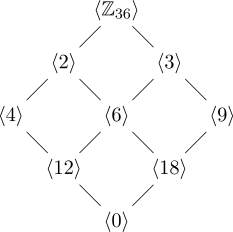
\(\langle 2\rangle \) and \(\langle 3\rangle \) are maximal ideals.
- 3.
- The ideal \(\langle x^2 + 1\rangle \) is maximal in \(\mathbb {R}[x]\). To show that this is the case, lets assume there is some ideal \(A\) that
properly contains \(\langle x^2 + 1\rangle \). We show that \(A = \langle x^2 + 1\rangle \). Thus \(\langle x^2 + 1\rangle \) is maximal.
Proof. Suppose \(R/A\) is an integral domain and \(ab\in A\). Then \((a + A)(b + A) = ab + A = A\), the zero elt of the ring \(R/A\). So, either at \(a + A = A\) or \(b + A = A\).
Thus either \(a\in A\) or \(b\in A\, \implies \, A\) is prime.
Conversely, suppose \(R/A\) is a commutative ring with unity for any proper ideal \(A\). We show that when
\(A\) is prime, \(R/A\) has no zero division. Suppose \(A\) is prime and \((a +A)(b + A) = 0 + A = A\). Then \(a\in A\) therefore \(a\in A\) and \(b\in A\). Thus one of \((a + A) \) or \((b + A)\)
is the zero coset in \(R/A\).
□
Proof. Suppose \(R/A\) is a field and \(B\) is an ideal of \(R\) that properly contains \(A\). Let \(b\in B,\, b\not \in A\). Then \(b+A \neq 0\) in \(R/A\) and
therefore there exist an elt \(c + A\) such that \((b + A)(c + A) = 1 + A\), the multiplicative identity of \(R/A\). Since \(b\in B\), we have \(bc\in B\) since \(1 + A = (b + A)(c + A) = bc + A\) so
we have \(1 - bc \in A\subset B\), so \(1 = (1 - bc) + bc \in B\). Thus \(B = R\) showing that \(A\) is maximal.
Now, suppose \(A\) is maximal and let \(b\in R\) but \(b\in \not A\). We show that \(b + A\) does not have a multiplicative inverse.
This follows from the fact that \(A\) is a maximal ideal.
□
Definition 3.5.7. Let \(\phi : R \longrightarrow S\) be a ring homomorphism. Then the kernel of \(\phi \) is \(ker\, \phi = \{r\in R\, |\, \phi _r = 0\}\).
Image
\(Im \,\phi = \{s\in S\, |\, s = \phi _r\) for \(r \in R\}\)
Theorem 3.5.8. For rings \(R,\, S\) and a homomorphism \(\phi : R\longrightarrow S\)
- 1.
- \(ker\, \phi \) is an ideal of \(R\).
- 2.
- \(Im\, \phi \) is a subring of \(R\).
- 3.
- \(Im\, \phi \) is isomorphic to the factor ring \(R/ker\, \phi \).
Proof.
- 1.
- Recall that \(ker\, \phi \subset R\) is a subgroup under addition. Let \(\, x\in ker\,\phi \,,\hspace {0.3cm} r\in R,\,\, r\in ker\,\phi \).
- 2.
- We just need to show that \(Im\, \phi \) is closed under multiplication. \(r_1, \, r_2 \in R\), then
\(\phi (r_1)\,\phi (r_2) = \phi (r_1r_2)\in Im\, \phi \).
Questions on this section
Stuck on something here? Ask below and it stays attached to this topic.