2.1 Class Equation
Let \(G\) be a finite group. Then the class equation of \(G\) is , \[\begin {vmatrix} G\\ \end {vmatrix} = \begin {vmatrix} Z(G)\\ \end {vmatrix} + \sum _i\Big [G:\, C_G(x_i)\Big ]\] where \(x_i\) is selected from each conjugacy class having more than one element.
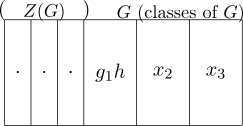
- •
- The elements in \(Z(G)\) are conjugates of themselves, thus they form their own individual classes of \(G\).
- •
- Other elements in \(G\) that are not self conjugates are paired with their conjugates in one
class. i.e \((g\cdot h)\) above.
Definition 2.1.1. Let \(p\) be a prime number, then a \(p-\)group of order \(p^n\, , \, \, n\geq 1\).
Proof. Consider the equation \(\begin {vmatrix} G\\ \end {vmatrix} = \begin {vmatrix} Z(G)\\ \end {vmatrix} + \sum \limits _i\big [G:\, C_G(x_i)\big ]\), each \(C_G(x_i)\) is a proper subset of \(G\) for each \(x_i\not \in Z(G)\). Now, since \(G\) is a \(p-\)group, \(\big [G:\, C_G(x_i)\big ]\) is
a divisor of \(p^n = \begin {vmatrix} G\\ \end {vmatrix}\). Hence, it is itself a power of \(p\). Thus \(p\) divides both of the terms in the class equation
other than \(\begin {vmatrix} Z(G)\\ \end {vmatrix}\), and so, \(p\begin {vmatrix} Z(G)\\ \end {vmatrix}\) as well. Therefore, \(Z(G)\neq \{e\}\).
□
Questions on this section
Stuck on something here? Ask below and it stays attached to this topic.