1.2 Cycle Notation
Suppose \(S\) has \(n\) elements as follows: \(\, \{1\, , \, 2\, , \, 3\, ,\cdots \cdots , \, n\}\). The elements of the symmetric group can be written as follows: for
\(\, \alpha :\, S\longrightarrow S\)
\[\alpha = \begin {pmatrix} 1 & 2 & 3 & \cdots \cdots & n\\ \alpha (1) & \alpha (2) & \alpha (3) & \cdots \cdots & \alpha (n)\\ \end {pmatrix}\]
Proof. Consider an element 1 in \(S\), there are \(n\) choices of \(\alpha (1)\). Once \(\alpha (1)\) is chosen, for \(\alpha (2)\), there are \(n-1\) choices,
since \(\alpha \) is \(1-1\). Since \(\alpha (2)\) is chosen, there are \(n-2\) possibilities for \(\alpha (3)\). Continuing in this way, we see that \(S_n\) has \(n(n-1)(n-2)\cdots \cdots 3\cdot 2\cdot 1\, \)
elements.
Thus \(\begin {vmatrix} S_n\\ \end {vmatrix} = n(n-1)(n-2)\cdots \cdots \, 3\cdot 2\cdot 1 = n!\)
□
- 1.
- On a square
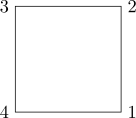
\[\rho = \begin {pmatrix} 1 & 2 & 3 & 4\\ 2 & 3 & 4 & 1\\ \end {pmatrix}\hspace {2cm} \phi = \begin {pmatrix} 1 & 2 & 3 & 4\\ 2 & 1 & 4 & 3\\ \end {pmatrix}\]
Rotation taking \(1\rightarrow 2\, ,\, 2\rightarrow 3\, ,\, 3\rightarrow 4\, \) and \(4\rightarrow 1\).
Reflection taking \(1\rightarrow 2\, ,\, 2\rightarrow 1\, , \, 3\rightarrow 4\, , \, 4\rightarrow 3\).
All these elements of the symmetry transformations can be achieved by the elements \(\rho \) and \(\phi \) and their compositions. The group formed is called the Dihedral group \(D_4\) and has \(4\times 2 = 8\) elements.
- 2.
- Consider a triangle, an “equilateral triangle”
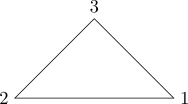
Also called the Dihedral group \(D_3\) and \(3\times 2 = 6\) elements.
Exercise 1.2.3. from (2) list all the elements of \(S_3\,\, \) e.d \(\begin {pmatrix} 1 & 2 & 3\\ 1 & 2 & 3\\ \end {pmatrix}\)
Proof. If \(\alpha \) and \(\beta \) are in \(S_n\) defined by \(\, \alpha = \begin {pmatrix} 1 & 2 & 3 & \cdots \cdots \\ 1 & 3 & 2 & \cdots \cdots \\ \end {pmatrix}\,\) and \(\, \beta = \begin {pmatrix} 1 & 2 & 3 & \cdots \cdots \\ 3 & 2 & 1 & \cdots \cdots \\ \end {pmatrix}\,\) with each element after 3 mapped onto itself. Then \(\, \beta o\alpha = \begin {pmatrix} 1 & 2 & 3 & \cdots \cdots \\ 3 & 1 & 2 & \cdots \cdots \\ \end {pmatrix}\,\) and
\(\, \alpha o\beta = \begin {pmatrix} 1 & 2 & 3 & \cdots \cdots \\ 2 & 3 & 1 & \cdots \cdots \\ \end {pmatrix}\). Thus \(\alpha o\beta \neq \beta o\alpha \, \) and the group is non-Abelian.
□
The Cycle notation
\(\alpha = \begin {pmatrix} 1 & 2 & 3 & \cdots \cdots \\ 1 & 3 & 2 & \cdots \cdots \\ \end {pmatrix} = (1) (23) (4)(5)\cdots \cdots = (2\, 3)= \) cycle notation.
Only \(2\rightarrow 3\) and \(3\rightarrow 2\) and the rest of the numbers are mapped onto themselves.
\(\begin {pmatrix} 1 & 2 & 3 & 4 & 5\\ 2 & 4 & 3 & 1 & 5\\ \end {pmatrix} = (1\,2\,4)(3)(5) = (1\,2\,4)\,\) is the cycle notation.
\(\begin {pmatrix} 1 & 2 & 3 & 4 & 5\\ 2 & 4 & 5 & 1 & 3\\ \end {pmatrix} = (1\, 2\, 4)(3\,5)= \begin {pmatrix} 1 & 2 & 3 & 4 & 5\\ 2 & 4 & 3 & 1 & 5\\ \end {pmatrix}\begin {pmatrix} 1 & 2 & 3 & 4 & 5\\ 1 & 2 & 5 & 4 & 3\\ \end {pmatrix} = \begin {pmatrix} 1 & 2 & 3 & 4 & 5\\ 2 & 4 & 5 & 1 & 3\\ \end {pmatrix}\)
\[=(1\, 2\, 4)(3\, 5)\,\, \text {as required}\]
Definition 1.2.6. Let \(S\) be a set and \(\, a_1\, ,\, a_2\,,\,\cdots \cdots \, a_k \in S\), then the permutation for which \(a_1\longmapsto a_2\,,\)
\(a_2\longmapsto a_3\, , \, \cdots \cdots ,\, a_{k -1} \longmapsto a_k\, ,\, a_k \longmapsto a_1\,\) can be represented as \((a_1a_2\cdots \cdots \, a_k)\).
Note. We say \((a_1a_2\cdots \cdots \, a_k)\) is of length \(k\).
Definition 1.2.8. Let \(a_i\in S\) and \(b_j\in S\) for \(1\leq i\leq m\,, \, 1\leq j\leq n\). The cycles \((a_1a_2\cdots \cdots \, a_m)\) and \((b_1b_2\cdots \cdots \, b_n)\) are disjoint if \(a_i\neq b_j\) for all \(i\, ,\ , j\)
e.g \(\, (1\, 2\, 3)\, , \, (6\, 1)\, , \, (4\, 5)\, , \, (1\,2)(6\,5)\)
- \(*\)
- \((1\, 2\,3)\) is disjoint to \((4\,5)\)
- \(*\)
- \((6\,1)\) is disjoint to \((4\, 5)\)
- \(*\)
- \((4\, 5)\) is disjoint to \((6\,1)\, , \, (1\, 2\, 3)\)
\((1\,2)(6\,5)\) is joint to all (not disjoint to any)
Note. Disjoint cycles commute. That is, if \(\alpha \) and \(\beta \) have no \(S\) elements in common, then \(\alpha \beta = \beta \alpha \).
Theorem 1.2.9. If the pair \(\alpha = (a_1a_2\cdots \cdots \, a_m)\) and \(\beta = (b_1b_2\cdots \cdots \, b_n)\) have no elements (entries) in common, then \(\alpha \beta = \beta \alpha \).
Proof. We can assume set \(S\) is of the form \(\, S = \{a_1a_2\cdots \cdots \, a_mb_1b_2\cdots \cdots \, b_nc_1c_2\cdots \cdots \, c_k\}\) where the \(c_{'s}\) are those elements which are fixed by both
\(\alpha \) and \(\beta \). We want to show that for any permutation \(X\), \(\,\, (\alpha \beta )(X) = (\beta \alpha )(X)\). Now, suppose \(X\) is any of the elements say
\(a_i\). Then;
\[(\alpha \beta )(a_i) = \alpha (\beta (a_i)) = \alpha (a_i) = a_{i+1}\]
since \(\beta \) fixes all \(a\) elements. Similarly \(\, (\alpha \beta )(b_j) = \alpha (\beta (b_j)) = \alpha (b_{j+1}) = b_{j+1}\,\) since \(\alpha \) fixes all \(b_js\) and \(\, (\beta \alpha )(b_i) = \beta (\alpha (b_j)) = \beta (b_j) = b_{j+1} \, \implies \alpha \beta = \beta \alpha \).
Now, since \(\alpha \) and \(\beta \) fix the \(cs\hspace {0.3cm}(\alpha \beta )(c_i) = \alpha (\beta (c_i)) = \alpha (c_i) = c_i)\) and
\((\beta \alpha )(c_j) = \beta (\alpha (c_j)) = \beta (c_j) = c_j\). Thus \(\alpha \) and \(\beta \) commute.
□
Example 1.2.10. Let \(\alpha = (1\, 2\, 3)\,\) and \(\, \beta = (4\, 5)\)
\(\alpha \beta = (1\, 2\, 3)(4\,5)\,\) or \(\, \begin {pmatrix} 1 & 2 & 3 & 4 & 5\\ 2 & 3 & 1 & 4 & 5\\ \end {pmatrix} \begin {pmatrix} 1 & 2 & 3 & 4 & 5\\ 1 & 2 & 3 & 5 & 4\\ \end {pmatrix} = \begin {pmatrix} 1 & 2 & 3 & 4 & 5\\ 2 & 3 & 1 & 5 & 4\\ \end {pmatrix} = (1\, 2\, 3)(4\, 5)\)
\(\beta \alpha = (4\, 5)(1\, 2\, 3) = \begin {pmatrix} 1 & 2 & 3 & 4 & 5\\ 1 & 2 & 3 & 5 & 4\\ \end {pmatrix}\begin {pmatrix} 1 & 2 & 3 & 4 & 5\\ 2 & 3 & 1 & 4 & 5\\ \end {pmatrix} = \begin {pmatrix} 1 & 2 & 3 & 4 & 5\\ 2 & 3 & 1 & 5 & 4\\ \end {pmatrix} = (1\, 2\, 3)(4\,5)\)
Proof. Let \(\alpha \) be a permutation on \(S = \{a_1\,, \, a_2\, \cdots \cdots \,, \, a_n\}\). To write \(\alpha \) in cycle form, we say
\(a_2 = \alpha (a_1)\,\,\,\,\, a_3 = \alpha (\alpha (a_1)) =\alpha ^2(a_1)\). Proceeding in this till we get back at \(a_1 = \alpha ^m(a_1)\) for some \(m\). Clearly such an \(m\) exists because \(a_1\, , \, \alpha (a_1)\, , \, \alpha ^2(a_1)\, \cdots \cdots \) is finite
so eventually there must be a repetition say \(\alpha ^i(a_1) = \alpha ^j(a_1)\) for some \(, i\, ,\, j\) with \(i<j\). Then \(a_1 = \alpha ^m(a_1)\) where \(m = j - i\). We express this
relationship among \(a_1\, , \, a_2\,, \cdots \cdots \, a_m.\hspace {0.3cm}\alpha = (a_1a_2\cdots \cdots \, a_m)....\)
In case the set \(S\) is not exhausted, we choose another element \(b_1\) of \(S\) not in the cycle \(\alpha \). We set \(b_2 = \alpha (b_1)\, , \, b_3 = \alpha ^2(b_1).....\) and
so on till \(b_1 = \alpha ^k(b_1)\) for some \(k\).
□
- 1.
- \(\alpha = (5\,6\,7) =(1)(2)\cdots \cdots (5\,6\,7)\,\) or \(\,(1)(2)(3)(5\,6\,7)\,\) or \(\, = (3)(5\,6\,7) = (4)(5\, 6\,7)\)
Definition 1.2.13. Given a permutation \(\alpha =(a_1a_2\cdots \cdots \, a_m)\), then \(\, \alpha ^{-1} = (a_ma_{m-1}\cdots \cdots \, a_2a1)\)
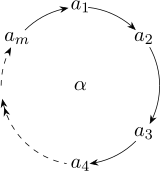 | 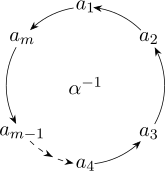 |
Check that \(\, \, \alpha \alpha ^{-1} = (1\,2\, 3)(3\,2\,1) = (1)\,\) (An identity map)
\[\begin {pmatrix} 1 & 2 & 3 \\ 2 & 3 & 1\\ \end {pmatrix}\begin {pmatrix} 3 & 2 & 1\\ 2 & 1 & 3\\ \end {pmatrix} = \begin {pmatrix} 1 & 2 & 3\\ 1 & 2 & 3\\ \end {pmatrix}\]
Proof. Consider the \(r\) cycle (cycle of length \(r\)). If then \(\beta \) is the identity.
e.g \(\, \, \begin {pmatrix} 1 & 2 & 3\\ 1 & 2 & 3\\ \end {pmatrix} = (2\,3)(3\,2) = 1\) an identity map.
So \(\beta = (1\,2)(1\,2)\) since \(\, (1\, 2)^{-1} = 12\).
If \(r\geq 2\), then \(\beta = (1\, 2\, 3\,\cdots \cdots \, r)\) which can be written a \(\beta = (1\,r)(1\,(r-1))\cdots \cdots (1\,2)\).
□
- (a)
- \((1\,2\,4\,5\,3) = (1\,3)(1\,5)(1\,4)(1\,2)\)
- (b)
- \((1\,3\,2)(1\,2\,3) = (1\,2)(1\,3)(1\,3)(1\,2)\)
Note.
- •
- These transpositions in the factorisation need not commute. This is true if they are not disjoint. E.g \((1\,3)(1\,2)\neq (1\,2)(1\,3)\)
- •
- The factors of the factorisation are not uniquely determined.
Definition 1.2.18. A permutation \(\alpha \in S_n\) is even if it can be factorised into a product of an even
number of transposition, otherwise it is old.
The parity of a permutation is whether it is even or old.
Definition 1.2.19. Two permutations \(\alpha \,,\, \beta \in S_n\) are said to have same cycle structure if their complete
factorisations have the same number of \(r-\)cycles for each \(r\).
Note. These are \(\, \dfrac {1}{r}[(n(n-1)(n-2)\, \cdots \cdots \, (n-r+1)]\,\) \(r-\)cycles in \(S_n\). E.G. The number of permutation in \(S_7\) of the form \((abc)(de)\) is \(\, \dfrac {1}{3}[7\cdot 6\cdot 5]\cdot \dfrac {1}{2}[4\cdot 3] = 70\cdot 6 = 420\)
Remark. If \(\alpha \, ,\, \gamma \in S_n\), then \(\alpha \, \gamma \,\alpha ^{-1}\) has the same Cycle structure as \(\gamma \).
Exercise 1.2.20. Find the number of permutations with cycle structure of the form \((ab)(cd)\,\) in \(S_4\) \(\hspace {0.5cm} 1\,\, 2\, \, 3\,\, 4\)
\( \hspace {0.3cm} n = 4\)
\[\dfrac {1}{2}\,\Big [\dfrac {1}{r}\, (a\, b) \cdot \dfrac {1}{r}\Big ] = \dfrac {1}{2}\Big [\dfrac {1}{2}\,(4\cdot 3)\cdot \dfrac {1}{2}\, (2\cdot 1)\Big ] = \dfrac {1}{2}\, 6 = S\]
Note. A cycle of odd length is even whilst that of even length is odd.
Definition 1.2.21. Let \(\alpha \in S_n\) such that its complete factorisation into disjoint cycles is \(\, \alpha = \beta _1\beta _2\cdots \cdots \beta _t\), then; Signum \(\alpha \) defined as \(Sgn = (-1)^{n-t}\)
- (a)
- If \(\gamma \) is a \(1-\)cycle, then the \(Sgn(\gamma )= 1\) since then \(n = t\).
\(\implies \, Sgn(\gamma ) = (-1)^{n-t} = (-1)^0 = 1\). - (b)
- If \(\zeta \) is a transposition, then it mean \(t = \underbrace {(n-2)}_{fixed}+ \underbrace {1}_{transposition} = n-1\). So
\(\, Sgn(\zeta ) = (-1)^{n-(n-1)} = -1^1 = -1\)
- (i)
- If \(\, \alpha \, , \, \zeta \in S_n\), where \(\zeta \) is a transposition, then \(\,Sgn\, \zeta (\alpha ) = -\, Sgn(\alpha )\).
- (ii)
- For all \(\, \alpha \, , \, \beta \in S_n\, , \, Sgn(\alpha \beta ) = Sgn(\alpha )\,Sgn(\beta )\)
In general; \(\, Sgn(\alpha _1\alpha _2\cdots \cdots \alpha _k) = Sgn(\alpha _1)\, Sgn(\alpha _2)\cdots \cdots Sgn(\alpha _k)\)
Proof.
(i)
Multiplying a permutation by a transposition changes the number of inversions by an odd amount, so it reverses parity. Hence \(\operatorname {Sgn}(\alpha \zeta ) = -\operatorname {Sgn}(\alpha )\).
(ii)
Write \(\beta \) as a product of \(k\) transpositions, so \(\operatorname {Sgn}(\beta ) = (-1)^{k}\). Applying part (i) \(k\) times to \(\alpha \beta \), \[\operatorname {Sgn}(\alpha \beta ) = (-1)^{k}\operatorname {Sgn}(\alpha ) = \operatorname {Sgn}(\alpha )\operatorname {Sgn}(\beta ).\] The general product formula follows by induction on the number of factors. □
Note. Part (ii) says the sign is a homomorphism from \(S_n\) to \(\{\pm 1\}\). Its kernel is the alternating group \(A_n\), which is therefore normal in \(S_n\) and of index two for \(n\geq 2\) — a fact obtained here without any computation, purely from the homomorphism property.
Theorem 1.2.23. Let \(\alpha \in S_n\) be a permutation then if \(Sgn(\alpha ) = 1\), then \(\alpha \) is even and if \(Sgn(\alpha ) = -1\), then \(\alpha \) is old.
Proof. Recall that for every transposition \(\zeta \), \(\,\, Sgn(\zeta ) = -1\). Therefore suppose \(\, \alpha = \zeta _1\, , \, \zeta _2\, \cdots \cdots \, \zeta _q\) is a function of \(\alpha \) into
transposition \(\, Sgn(\alpha ) = Sgn(\zeta _1)\,Sgn(\zeta _2)\,\cdots \cdots \, Sgn(\zeta _q) = (-1)^q\). Therefore
If \(\, (-1)^q = 1\), then \(q\) is even \(\implies \alpha \) is even
If \(\, (-1)q = -1\), then \(q\) is odd \(\implies \alpha \) is odd.
□
- 1.
- \(\alpha = \begin {pmatrix} 1 & 2 & 3 & 4 & 5 & 6\\ 2 & 6 & 3 & 1 & 5 & 4\\ \end {pmatrix}\hspace {1.5cm} \beta = \begin {pmatrix} 1 & 2 & 3 & 4 & 5 & 6\\ 1 & 6 & 4 & 4 & 3 & 2\\ \end {pmatrix}\,\,\) in \(S_6\).
Solution. \(\alpha = (1\, 2\, 6\, 4)(3)(5)\,\,\) thus \(t = 3\, \) disjoint cycles, so that
\(\, Sgn(\alpha ) = (-1)^{n-t} = (-1)^{6-3} = (-1)^3 = -1\) hence \(\alpha \) is odd.
\(\beta = (1)(2\,6)(3\,4\,5)\), that \(t=3\implies \, Sgn(\beta ) = (-1)^{6-3} = -1\)
- 2.
- Suppose \(\, \gamma = \begin {pmatrix} 1 & 2 & 3 & 4 & 5 & 6\\ 1 & 2 & 3 & 4 & 5 & 6\\ \end {pmatrix}\)
\[\implies \, \gamma = (1)(2)(3)(4)(5)(6)\, \implies Sgn(\gamma ) = (-1)^{6-6} = 1\]
Consider the subset of even permutations of \(S_n\). Now, such (even)(even) \(= \) even. Thus, this subset is
closed under composition.
Definition 1.2.25. The set of even permutations in \(S_n\) is called the alternating group denoted as
\(A_n\).
Exercise 1.2.26. Show/prove that \(A_n\) satisfies the group axioms.
Proof. (By nemwine!!)
Let \(\, \alpha \, , \, \beta \) and \(\delta \in A_n\) (be even permutations) then; □
- (i)
- \((\alpha \cdot \beta )\cdot \delta = \alpha \cdot (\beta \cdot \delta )\,\) since the product of even permutation is even \(= 1\).
- (ii)
- \(\exists \, e = (1)\in \, A_n \ni \, \alpha (1) = (1)\alpha = \alpha \,\) which is even.
- (iii)
- \(\forall x\in A_n\, \exists \, \alpha ^{-1}\in A_n\,\ni \, \alpha \alpha ^{-1} = \alpha ^{-1}\alpha = 1\) where \(\alpha ^{-1}\) is the inverse of \(\alpha \).
Example 1.2.27. \(S_3 =\{(1)\, , \, (1\,2)\, , \, (1\,3)\, , \, (2\, 3)\, ,\, (1\, 2\, 3)\, , \, (1\, 3\, 2)\}\) \(A_3 = \{(1)\, , \, (1\, 2\, 3)\, ,\, (1\,3\, 2)\}\)
Solution. The elements of \(S_4\) include;
| \(\checkmark \,\,(1)\hspace {0.6cm} \begin {pmatrix} 1 & 2 & 3 & 4\\ 1 & 2 & 3 & 4\\ \end {pmatrix} = (1)\) | \(\checkmark \,\,(2)\hspace {0.6cm}\begin {pmatrix} 1 & 2 & 3 & 4\\ 2 & 1 & 3 & 4\\ \end {pmatrix} = (1\, 2)(3)(4)\) | ||
| \((3)\hspace {0.6cm}\begin {pmatrix} 1 & 2 & 3 & 4\\ 3 & 1 & 2 & 4\\ \end {pmatrix} = (1\, 3 \, 2)(4)\) | \(\checkmark \,\,(4)\hspace {0.6cm}\begin {pmatrix} 1 & 2 & 3 & 4\\ 3 & 2 & 1 & 4\\ \end {pmatrix} = (1\, 3)(2)(4)\) | ||
| \((5)\hspace {0.6cm}\begin {pmatrix} 1 & 2 & 3 & 4\\ 2 & 3 & 1 & 4\\ \end {pmatrix} = (1\, 2\, 3)(4)\) | \(\checkmark \,\, (6)\hspace {0.6cm}\begin {pmatrix} 1 & 2 & 3 & 4\\ 1 & 3 & 2 & 4\\ \end {pmatrix} = (1)(2\, 3)(4)\) | ||
| \((7)\hspace {0.6cm}\begin {pmatrix} 1 & 2 & 3 & 4\\ 1 & 3 & 4 & 2\\ \end {pmatrix} = (1)(2\,3\,4)\) | \(\checkmark \,\, (8)\hspace {0.6cm}\begin {pmatrix} 1 & 2 & 3 & 4\\ 1 & 4 & 3 & 2\\ \end {pmatrix} = (1)(2\,4)(3)\) | ||
| \((9)\hspace {0.6cm}\begin {pmatrix} 1 & 2 & 3 & 4\\ 3 & 1 & 4 & 2\\ \end {pmatrix} = (1\, 3\,4\,2)\) | \(\checkmark \,\, (10)\hspace {0.6cm}\begin {pmatrix} 1 & 2 & 3 & 4\\ 3 & 4 & 1 & 2\\ \end {pmatrix} = (1\, 3)(2\,4)\) | ||
| \((11)\hspace {0.6cm}\begin {pmatrix} 1 & 2 & 3 & 4\\ 4 & 3 & 1 & 2\\ \end {pmatrix} = (1\, 4\, 2\,3)\) | \((12)\hspace {0.6cm}\begin {pmatrix} 1 & 2 & 3 & 4\\ 4 & 1 & 3 & 2\\ \end {pmatrix} = (1\, 4\, 2)(3)\) | ||
| \(\checkmark \,\, (13)\hspace {0.6cm} \begin {pmatrix} 1 & 2 & 3 & 4\\ 1 & 2 & 4 & 3\\ \end {pmatrix} = (1)(2)(4\,3)\) | \((14)\hspace {0.6cm}\begin {pmatrix} 1 & 2 & 3 & 4\\ 1 & 4 & 2 & 3\\ \end {pmatrix} = (1) (2\, 4\, 3)\) | ||
| \(\checkmark \,\, (15)\hspace {0.6cm} \begin {pmatrix} 1 & 2 & 3 & 4\\ 2 & 1 & 4 & 3\\ \end {pmatrix} = (1\,2)(3\,4)\) | \((16)\hspace {0.6cm} \begin {pmatrix} 1 & 2 & 3 & 4\\ 2 & 4 & 1 & 3\\ \end {pmatrix} = (1\, 2\, 4\, 3)\) | ||
| \((17)\hspace {0.6cm}\begin {pmatrix} 1 & 2 & 3 & 4\\ 2 & 3 & 4 & 1\\ \end {pmatrix} = (1\, 2\, 3\, 4)\) | \((18)\hspace {0.6cm}\begin {pmatrix} 1 & 2 & 3 & 4\\ 4 & 1 & 2 & 3\\ \end {pmatrix} = (1\, 4\, 3\, 2)\) | ||
| \((19)\hspace {0.6cm}\begin {pmatrix} 1 & 2 & 3 & 4\\ 2 & 3 & 4 & 1\\ \end {pmatrix} = (1\, 2\, 3\, 4)\) | \((20)\hspace {0.6cm}\begin {pmatrix} 1 & 2 & 3 & 4\\ 2 & 4 & 3 & 1\\ \end {pmatrix} = (1\, 2\, 4)(3)\) | ||
| \((21)\hspace {0.6cm}\begin {pmatrix} 1 & 2 & 3 & 4\\ 3 & 4 & 2 & 1\\ \end {pmatrix} = (1\, 3\, 2 \, 4)\) | \((22)\hspace {0.6cm}\begin {pmatrix} 1 & 2 & 3 & 4\\ 3 & 2 & 4 & 1\\ \end {pmatrix} = (1\, 3\, 4)(2)\) | ||
| \(\checkmark \,\, (23)\hspace {0.6cm} \begin {pmatrix} 1 & 2 & 3 & 4\\ 4 & 2 & 3 & 1\\ \end {pmatrix} = (1\, 4)(2)(3)\) | \(\checkmark \,\, (24)\hspace {0.6cm}\begin {pmatrix} 1 & 2 & 3 & 4\\ 4 & 3 & 2 & 1\\ \end {pmatrix} = (1\, 4)(2\, 3)\) |
Therefore, the elements of \(A_4\). \[A_4 = \{(1)\, ,\, (1\,2\,3)(4)\, ,\, (1\, 3\, 2)(4)\, , \, (1\, 3)(2\, 4)\, , \, (1\, 4\,2)(3)\, , \, (1)(2\, 4\, 3)\, , \, (1\,2)(3\,4)\,,\, (1\, 4\, 3)(2)\, , \, (1\, 2\, 4)(3)\] \[\,,\, (1\, 3\, 4)(2)\, ,\, (1\, 4)(2\,3)\}\]
\(\therefore \,\, A_4\) has 12 elements.
Proof. For each old permutation \(\alpha \) in \(S_n\) the permutation \((1\,2)\alpha \) is even. Thus there are atleast as many
even permutations as there are odd.
For \(\beta \) an even permutation, \((1\,2)\beta \) is odd. So, there are atleast as many odd permutations as there are
even ones.
Thus the number of even permutations is equal to the numbers of odd permutations. Now \(\begin {vmatrix} S_n\\ \end {vmatrix} = n! \implies \begin {vmatrix} A_n\\ \end {vmatrix} = \dfrac {1}{2}\, n!\)
where \(\begin {vmatrix} S_n\\ \end {vmatrix} = \) length of \(S_n\) (number of elements in \(S_n\)).
□
Questions on this section
Stuck on something here? Ask below and it stays attached to this topic.