1.5 Lagrange’s Theorem
If \(H\) is a subgroup of a finite group \(G\), then \(\begin {vmatrix} H\\ \end {vmatrix}\) divides \(\begin {vmatrix} G\\ \end {vmatrix}\).
Proof. Suppose \(\{a_1H\, , \, a_2H\, , \, \cdots \cdots \, \, a_kH\}\) is a family of distinct cosets of \(H\) in \(G\). Then \(G = a_1H\cup a_2H \cup \, \cdots \cdots \, \cup a_kH\), since each \(g\in G\) lies in some coset of \(H = a_iH\) for
some \(i\). Moreover, we know that cosets \(a_i H\) and \(a_jH\) are disjoint. Therefore, \(\begin {vmatrix} G\\ \end {vmatrix} = \begin {vmatrix} a_1 H\\ \end {vmatrix} + \begin {vmatrix} a_2 H\\ \end {vmatrix} + \cdots \cdots + \begin {vmatrix} a_k H\\ \end {vmatrix}\). But \(\, \begin {vmatrix} a_i H\\ \end {vmatrix} = \begin {vmatrix} H\\ \end {vmatrix}\) for all \(i\) \(\implies \, \begin {vmatrix} G\\ \end {vmatrix} = \begin {vmatrix} H\\ \end {vmatrix} + \begin {vmatrix} H\\ \end {vmatrix} + \cdots \cdots \cdots = k \begin {vmatrix} H\\ \end {vmatrix}.\,\,\) Thus \(\begin {vmatrix} H\\ \end {vmatrix}\) goes
into \(\begin {vmatrix} G\\ \end {vmatrix}\, \, k\) times. Thus \(\begin {vmatrix} H\\ \end {vmatrix}\) divides \(\begin {vmatrix} G\\ \end {vmatrix}\)
□
Definition 1.5.1. The index of a group \(H\) in \(G\) is the number of cosets of \(H\) in \(G\). It is denoted as \(\, \big [G\, :\, H\big ]\).
Note. \(\, \begin {vmatrix} G\\ \end {vmatrix} = \big [G\, :\, H\big ]\begin {vmatrix} H\\ \end {vmatrix}\)
- 1.
- Consider the example of \(\, H = \{0\, , \ , 3\, , \, 6\}\) in \(G = \mathbb {Z}_9\) \begin {align*} G & = 0 + H\cup 1 + H\cup 2 + H\\ & = \{0, \, 3, \, 6\} + \{1, \, 4, \, 7\} \cup \{2, \, 5,\, 8\}\\\\ \begin {vmatrix} G\\ \end {vmatrix} & = \begin {vmatrix} \{0\, , \, 3\, , \, 6\}\\ \end {vmatrix} + \begin {vmatrix} \{1\, , \, 4\, , \, 7\}\\ \end {vmatrix} + \begin {vmatrix} \{2\, , \, 5\, , \, 5\}\\ \end {vmatrix}\\ & = 3\begin {vmatrix} H\\ \end {vmatrix} \end {align*}
Thus the index of \(H\) in \(G\) is 3.
- 2.
- Index of \(\langle (12)\rangle \) is \(S_3\). \begin {align*} \langle (12)\rangle & = \big \{(12)^n:\, 1\leq n\leq \begin {vmatrix} (12)\\ \end {vmatrix}\big \} = \big \{(12)^n:\, 1\leq n\leq 2\big \} = \big \{(12)\, , \, (1)\big \}\\\\ \therefore \,\, \begin {vmatrix} \langle (12)\rangle \\ \end {vmatrix} = 2\hspace {0.5cm},\hspace {0.5cm} \begin {vmatrix} S_3\\ \end {vmatrix} = 6 \end {align*}
Therefore, \(\big [S_3:\, \langle (12)\rangle \big ] = \dfrac {6}{2} = 3\)
- 3.
- Index \(\langle 2\rangle \) in \(\mathbb {Z}_{10}\).
\(\langle 2\rangle = \{2\, , \, 4\, , \, 6\, , \, 8\, , \, 0\}\hspace {1cm}\) (here we use addition)
\(\implies \, \, \langle 2\rangle = \big \{2^r:\, 1\leq r\leq 5\big \}\hspace {0.3cm}\implies 2 + 2 + 2 + 2+ 2 + 2 = 0\)
\[\implies \, 2^5 = e\] \[\begin {vmatrix} \langle 2\rangle \\ \end {vmatrix} = 5\hspace {0.5cm},\hspace {0.5cm}\begin {vmatrix} \mathbb {Z}_{10}\\ \end {vmatrix} = 10\] \(\therefore \,\, \big [\mathbb {Z}_{10}\, , \, \langle 2\rangle \big ] = 2\)
Corollaries
- 1.
- If \(G\) is a finite group and \(a\in G\), then the order of \(a\) is a division of the order \(G\).
Proof. Denote order of \(a\) as \(\begin {vmatrix} a\\ \end {vmatrix}\). \(\, \langle a\rangle \) is a subgroup of \(G\). By Lagrange’s theorem, \(\, \begin {vmatrix} \langle a \rangle \\ \end {vmatrix}\) divides \(\begin {vmatrix} G\\ \end {vmatrix}\). Thus, the order of \(a\) divides the order of \(G\).
□ - 2.
- A group \(G\) of prime order contains no subgroup other than \(\{e\}\)
Proof. This is a direct consequence of the Lagrange’s theorem since a prime has no positive divisions other than 1 and itself.
□ - 3.
- Every group of prime order is cyclic and is generated by any one of its non-identity
elements.
Proof. If \(a\in G\, ,\, \, a\neq e\). Then \(\langle a\rangle \neq \{e\}\). Then by preceding corollary \(\langle a\rangle = G\).
□
Note. Lagrange’s theorem does not say that if \(k\) is a divisor of \(\begin {vmatrix} G\\ \end {vmatrix}\), then \(G\) has a subgroup of order
\(k\). On the other hand, the following theorem is always true.
Theorem 1.5.4. Let \(G\) be a Cyclic group of (finite) order \(n\). i.e \(G = \langle a\rangle = \{e\, , \, a\, , \, a^2\, , \, \cdots \cdots \, a^{n-1}\}\).
- (i)
- Every subgroup of \(G\) is Cyclic.
- (ii)
- If \(1\leq k\leq n\), then \(a^k\) generates a subgroup of order \(\, \dfrac {n}{(k\, ,\, n)}\,\) where \((k\,,\, n)\) is the greatest common divisor of \(k\,, \, n\).
- (iii)
- For each positive divisor of \(n,\, G\) has exactly one subgroup of order \(d\).
- 1.
- \(\mathbb {Z}_{12}\, \) has 12 elements.
\(\implies \, \langle 1\rangle = \mathbb {Z}_{12}\,\) divisors of 12 are \(1\, , \, 2\,,\, 3\, , \, 4\, ,\, 6\, , \, 12\)
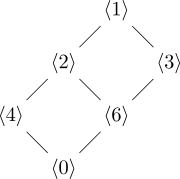
Possible subgroups will have orders. \[\dfrac {12}{(1\, , \, 12)}\, , \, \, \dfrac {12}{(2\, , \, 12)}\, , \,\, \dfrac {12}{(3\, , \, 12)}\, ,\, \, \dfrac {12}{(4\, , \, 12)}\, , \,\, \dfrac {12}{(6\,\, 12)}\, , \, \, \dfrac {12}{(12\, ,\, 12)}\] \[12\, , \, 6\, ,\, 4\, , \, 3\,,\, 2\, , \, 1\] Hence \(\mathbb {Z}_{12}\) has the following subgroups: \begin {align*} \mathbb {Z}_{12} & = \{0\, , \, 1\, , \, 2\, ,\, 3\,, \, 4\, , \, 5\, , \, 6\, , \, 7\, , \, 8\, , \, 9\, , \, 10\, , \, 11\}\cong \langle 1\rangle \\ \mathbb {Z}_{12/2} & = \{0\, , \, 2\, , \, 4\, , \, 6\, , \, 8\, , \, 10\} = \langle 2\rangle \\ \mathbb {Z}_{12/3} & = \{0\, , \, 3\, , \, 6\, , \, 9\} \cong \langle 3\rangle \\ \mathbb {Z}_{12/4} & = \{0\, , \, 4\, , \, 8\} \cong \langle 4\rangle \\ \mathbb {Z}_{12/6} & = \{0\, ,\, 6\} \cong \langle 6\rangle \\ \mathbb {Z}_{12/12} & = \{0\} \cong \langle 0\rangle . \end {align*}
One may construct the subgroup lattice.
- 2.
- Determine the subgroup lattice for \(\mathbb {Z}_{p^2q}\), where \(p\, q\) are prime.
Solution. Divisors for \(\begin {vmatrix} \mathbb {Z}_{p^2q}\\ \end {vmatrix}\) are \(1\, , \, p\, , \, q\, , \, p^2\, , \, pq\,, \, p^2q\). Now each divisor \(d\), there is a subgroup of order \(d\).Namely \[\langle 1\rangle \, , \, \langle pq\rangle \,,\, \langle p^2\rangle \, , \, \langle q\rangle \, , \, \langle p\rangle \, , \, \langle 0\rangle \]
generates (Subgroup order) Subgroup Lattice \(\langle 1\rangle = p^2q\) 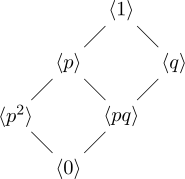
\(\langle p\rangle = pq\) \(\langle q\rangle = p^2\) \(\langle pq\rangle = p\) \(\langle p^2\rangle = q\) \(\langle 0\rangle = 1\)
Questions on this section
Stuck on something here? Ask below and it stays attached to this topic.