13.2 Zero eigenvalue: saddle-node, transcritical and pitchfork
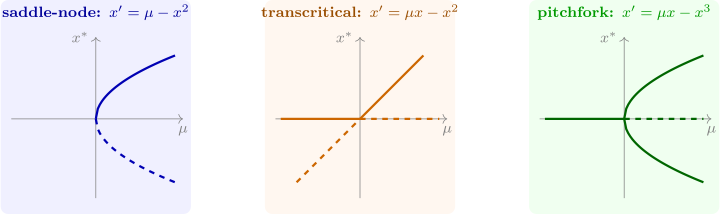
When one real eigenvalue vanishes, the dynamics near the bifurcation reduce (by the centre manifold theorem, which we do not prove) to a scalar equation \(x' = g(x, \mu )\) along the corresponding eigenvector. Three normal forms cover the common cases (Figure 17).
- 1.
- Saddle-node: \(x' = \mu - x^2\). For \(\mu < 0\) there are no equilibria; at \(\mu = 0\) one; for \(\mu > 0\) two, \(\pm \sqrt \mu \), the positive one stable. It occurs whenever \(g_x = 0\), \(g_\mu \neq 0\) and \(g_{xx} \neq 0\) at the bifurcation point; it is the generic way for equilibria to be created or destroyed, as in the fishery of Example 1.6.2.
- 2.
- Transcritical: \(x' = \mu x - x^2\). The equilibria \(0\) and \(\mu \) cross at \(\mu = 0\) and exchange stability. It is typical when an equilibrium exists for all \(\mu \), such as the zero population of Problem 1.8.7.
- 3.
- Pitchfork: \(x' = \mu x - x^3\) (supercritical) or \(x' = \mu x + x^3\) (subcritical). It is typical in systems with the symmetry \(x \mapsto -x\). In the supercritical case, the equilibrium \(0\) loses stability at \(\mu = 0\) and two stable equilibria \(\pm \sqrt \mu \) branch off: a symmetric beam under increasing load buckles to one side or the other. In the subcritical case the branches \(\pm \sqrt {-\mu }\) are unstable and exist before the bifurcation; past it there is no nearby stable state, and the system jumps to a distant one.
Questions on this section
Stuck on something here? Ask below and it stays attached to this topic.