12.4 Liénard systems and the van der Pol oscillator
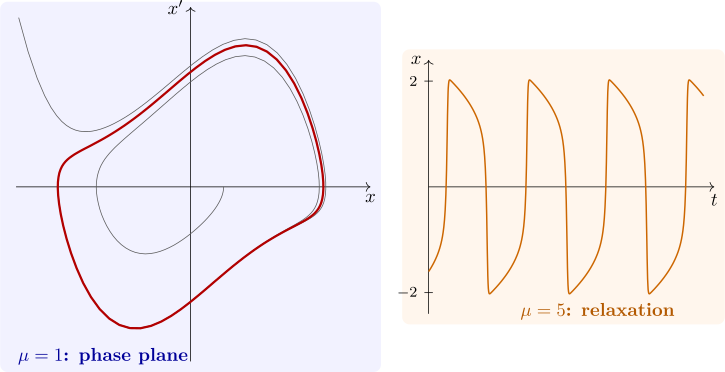
Van der Pol (1926) modelled a triode oscillator by \[ x'' - \mu (1 - x^2)x' + x = 0, \qquad \mu > 0 . \] The damping coefficient \(-\mu (1 - x^2)\) is negative for \(|x| < 1\), pumping energy into small oscillations, and positive for \(|x| > 1\), removing it from large ones, so one expects an oscillation of intermediate size at which the two balance. This is a case of a general theorem.
Theorem 12.4.1 (Liénard). Consider \(x'' + h(x)x' + g(x) = 0\), and let \(H(x) = \int _0^xh(s)\,ds\). Suppose that \(h\) and \(g\) are \(C^1\), \(g\) is odd with \(xg(x) > 0\) for \(x \neq 0\), \(h\) is even, and \(H\) has a single positive zero \(a\), with \(H < 0\) on \((0, a)\), \(H > 0\) and increasing on \((a, \infty )\), and \(H(x) \to \infty \) as \(x \to \infty \). Then the equation has exactly one periodic orbit, and it is a stable limit cycle attracting every orbit except the equilibrium.
We omit the proof, which uses the Liénard plane variables \(x\) and \(y = x' + H(x)\) and an energy estimate along orbits. Van der Pol’s equation satisfies the conditions with \(h = -\mu (1 - x^2)\), \(g = x\), \(H = -\mu (x - x^3/3)\) and \(a = \sqrt 3\).
Small \(\mu \): the amplitude by averaging
For small \(\mu \) the solution is nearly \(x = r\cos t\). The energy \(E = \frac 12(x^2 + x'^2)\) changes at the rate \(E' = x'(x'' + x) = \mu (1 - x^2)x'^2\). Averaging over one period of the unperturbed motion, with \(x = r\cos t\), \(x' = -r\sin t\), \[ \langle E'\rangle = \mu r^2\bigl \langle (1 - r^2\cos ^2t)\sin ^2t\bigr \rangle = \mu r^2\Bigl (\frac 12 - \frac {r^2}{8}\Bigr ) , \] using \(\langle \sin ^2t\rangle = \frac 12\) and \(\langle \cos ^2t\sin ^2t\rangle = \frac 18\). The energy is in balance when \(r^2 = 4\): the limit cycle has amplitude \(2\), whatever \(\mu \), to first order, and it is stable because \(\langle E'\rangle \) is positive for \(r < 2\) and negative for \(r > 2\). The period is close to \(2\pi \).
Large \(\mu \): relaxation oscillations
For large \(\mu \), in Liénard’s variable \(y = x'/\mu + x^3/3 - x\), the system becomes \(x' = \mu (y - (x^3/3 - x))\), \(y' = -x/\mu \): \(x\) is fast and \(y\) slow. The orbit creeps slowly along the outer branches of the cubic \(y = x^3/3 - x\) and jumps quickly between them, producing a relaxation oscillation, a slow build-up followed by a sudden discharge (Figure 16). Integrating the slow motion along a branch gives the period \(T \approx (3 - 2\log 2)\mu \), with a correction of order \(\mu ^{-1/3}\). Relaxation oscillations describe the heartbeat (van der Pol and van der Mark 1928), neuron spikes and the dripping of a tap.
Questions on this section
Stuck on something here? Ask below and it stays attached to this topic.