6.5 Practice Problems
Problem 6.1. A random sample of size ten is drawn from a continuous population: \[0.621,\ 0.503,\ 0.203,\ 0.477,\ 0.710,\ 0.581,\ 0.329,\ 0.480,\ 0.554,\ 0.382 .\] Test the hypothesis that the sample came from the Uniform\([0,1]\) distribution. Obtain \(F_0\), \(\widehat {F}_n\), \(D^{+}\), \(D^{-}\) and \(D\); give the critical value at \(\alpha = 0.05\) and state the conclusion.
Show solution
Solution. Hypotheses. \(H_0 : F = F_0\) where \(F_0\) is the Uniform\([0,1]\) cdf, against \(H_1 : F \neq F_0\). Note \(F_0\) is fully specified in advance, with no parameter estimated from the data — which is what makes the tabulated critical values applicable.
The theoretical cdf. For the uniform distribution on \([0,1]\), \(F_0(x) = x\) on that interval. The arithmetic is therefore unusually transparent: the theoretical value at each point is the observation.
Order the sample and tabulate.
| \(i\) | \(x_{(i)}\) | \(F_0 = x_{(i)}\) | \(\dfrac {i}{n}\) | \(\dfrac {i}{n}-F_0\) | \(F_0 - \dfrac {i-1}{n}\) |
| 1 | 0.203 | 0.203 | 0.1 | \(-0.103\) | \(0.203\) |
| 2 | 0.329 | 0.329 | 0.2 | \(-0.129\) | \(0.229\) |
| 3 | 0.382 | 0.382 | 0.3 | \(-0.082\) | \(0.182\) |
| 4 | 0.477 | 0.477 | 0.4 | \(-0.077\) | \(0.177\) |
| 5 | 0.480 | 0.480 | 0.5 | \(\ \ 0.020\) | \(0.080\) |
| 6 | 0.503 | 0.503 | 0.6 | \(\ \ 0.097\) | \(0.003\) |
| 7 | 0.554 | 0.554 | 0.7 | \(\ \ 0.146\) | \(-0.046\) |
| 8 | 0.581 | 0.581 | 0.8 | \(\ \ 0.219\) | \(-0.119\) |
| 9 | 0.621 | 0.621 | 0.9 | \(\ \ 0.279\) | \(-0.179\) |
| 10 | 0.710 | 0.710 | 1.0 | \(\ \ \mathbf {0.290}\) | \(-0.190\) |
The statistics. \[D^{+} = \max _i\left \{\dfrac {i}{n}-F_0\left (x_{(i)}\right )\right \} = 0.290 \quad (\text {at } i = 10),\] \[D^{-} = \max _i\left \{F_0\left (x_{(i)}\right )-\dfrac {i-1}{n}\right \} = 0.229 \quad (\text {at } i = 2),\] \[D = \max \left (D^{+}, D^{-}\right ) = 0.290 .\]
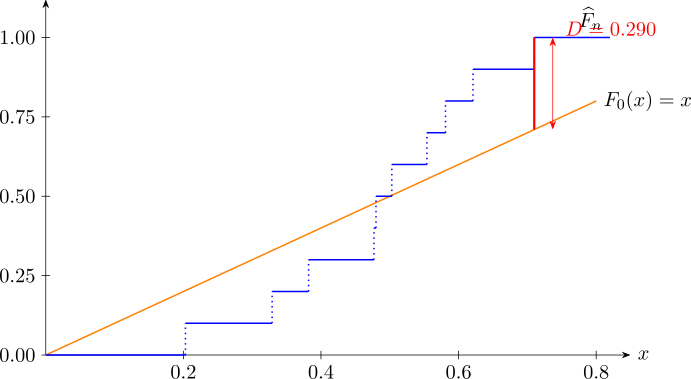
Critical value and decision. For \(n = 10\) at \(\alpha = 0.05\) the two-sided critical value is \(D_{0.05,10} = 0.409\). Since \[0.290 < 0.409,\] we do not reject \(H_0\): the sample is consistent with Uniform\([0,1]\).
Why both \(D^{+}\) and \(D^{-}\) are needed. The empirical distribution function is a step function, so at each observation it jumps from \(\frac {i-1}{n}\) to \(\frac {i}{n}\). The largest gap between \(\widehat {F}_n\) and \(F_0\) may occur immediately after a jump, which \(D^{+}\) measures, or immediately before one, which \(D^{-}\) measures. Taking only one of them would understate the distance — here \(D^{+}\) happens to win, but the maximum deviation of the two occurs at opposite ends of the sample, \(i = 10\) and \(i = 2\).
Questions on this section
Stuck on something here? Ask below and it stays attached to this topic.