2.1 The Gamma Function
The Gamma function is one of the special functions that have wide applications in mathematical and physical sciences. In particular it is used to evaluate certain improper integrals in terms of Gamma functions, and also in probability theory.
Definition 2.1.1 (Gamma function). We define the Gamma function of \(x\in \mathbb {R}\) by \[\Gamma (x) = \int _0^{\infty } t^{x-1}\, e^{-t}\, dt.\]
If \(x\geq 1\) this integral is of the first kind, and is convergent since we can compare it with
\[\int _1^{\infty } \frac {1}{t^2}\, dt.\]
We have
\[\lim _{t\rightarrow \infty } \frac {t^{x-1}\, e^{-t}}{1/t^2} = \lim _{t\rightarrow \infty } \frac {t^{x+1}}{e^t} = 0\]
by L’Hospital’s rule.
If \(x <1\), the integral is of mixed type with a singularity at \(t = 0\). So we consider the integral
\[\int _0^1t^{x-1}\, e^{-t}\, dt\]
of the second kind. By limit test of integrals of second kind, we have
\[\lim _{t\rightarrow 0} \frac {t^{x -1}\, e^{-t}}{t^{x - 1}} = \lim _{t\rightarrow 0} e^{-t} = 1\]
and
\[\int _0^1\frac {1}{t^{1-x}}\, dt\]
converges if \(1-x < 1\) or \(x>0\). And the integral diverges when \(x \leq 0\). Hence \(\Gamma (x)\).
- (a).
- \(\Gamma (1) = 1\)
- (b).
- \(\Gamma (x + 1) = x\, \Gamma (x)\)
- (c).
- if \(x\in \mathbb {N}\), \(\, \Gamma (x + 1) = x!\)
Proof. \[\Gamma (x) = \int _0^{\infty } t^{x-1}\, e^{-t}\, dt.\]
- (a).
- \(\Gamma (1) = \displaystyle {\int ^{\infty }_0}e^{-t}\, dt = \lim _{b\rightarrow \infty }\left [-e^{-t}\right ]_0^b = 1.\)
- (b).
- \(\Gamma (x + 1) = \displaystyle {\int _0^{\infty } t^x\, e^{-t}\, dt}\) integrating by parts, let \(u = t^x, \hspace {0.3cm} du = xt^{x-1}, \hspace {0.3cm} dv = e^{-t}\, dt, \hspace {0.3cm} v = -e^{-t}\) \begin {align*} \Gamma (x + 1) & = \lim _{b\rightarrow \infty }\left [-t^x\, e^{-t}\Big |_0^b + x\int _0^{\infty } t^{x - 1}\, e^{-t}\, dt\right ]\\ & = x\int _0^{\infty } t^{x - 1}\, e^{-t}\, dt\\ & = x\Gamma (x). \end {align*}
- (c).
- If \(x\in \mathbb {N}\), using part (b) repeatedly we get \begin {align*} \Gamma (x + 1) & = x\Gamma (x)\\ & = x(x-1)\Gamma (x-1)\\ & = x(x-1)(x-2)(x-3)\, \cdots \, 3\cdot 2\cdot \, 1\, \Gamma (1)\\ & = x(x-1)(x-2)(x-3)\, \cdots \, 3\cdot 2\cdot 1\\ & = x! \end {align*}
Proof. Let \(t = u^2, \hspace {0.3cm} dt = 2udu, \,\) when \(t = 0, \,\, u = 0\); when \(t = \infty , \, u = \infty \). \begin {align*} \Gamma (x) & = \int _0^{\infty }t^{x-1}\, e^{-t}\, dt\\ & = \int _0^{\infty } u^{2x-2}\, e^{-u^2}\cdot 2u\, du\\ & = 2\int _0^{\infty }u^{2x-1}\, e^{-u^2}\, du\\ & = 2\int _0^{\infty } t^{2x - 1}\, e^{t^2}\, dt. \end {align*} □
Theorem 2.1.4. \[\int _0^{\frac {\pi }{2}}\cos ^{2x - 1}\theta \, \sin ^{2y-1}\theta \, d\theta = \frac {\Gamma (x)\, \Gamma (y)}{2\Gamma (x+y)}.\]
Proof. We evaluate the double integral \[I = \iint _R \exp \left (-t^2 - u^2\right )\, t^{2x-1}\, u^{2y-1}\, dt\, du\] where \(R\) is the first quadrant of the tu-plane. In Cartesian from we have \begin {align*} I & = \int ^{\infty }_0\int _0^{\infty } \exp \left (-t^2-u^2\right ) \, t^{2x-1}\, u^{2y-1}\, dt\, tu\\ & = \int ^{\infty }_0e^{-t^2}\, t^{2x-1}\, dt\, \int ^{\infty }_0e^{-u^2}\, u^{2y-1}\, du\\ & = \frac {1}{2}\Gamma (x)\, \frac {1}{2}\Gamma (y)\\ & = \frac {1}{4}\Gamma (x)\, \Gamma (y), \hspace {0.3cm}\text {by}\,\, 2.3 \end {align*}
Next, integrating the \(I\) in polar form i.e with \(t = r\cos \theta , \hspace {0.3cm} u = r\sin \theta ,\hspace {0.3cm} dtdu = rdr\, d\theta \) \begin {align*} I & = \int _{r=0}^{\infty } \int _0^{\frac {\pi }{2}} \exp \left (-r^2\cos ^2\theta - r^2\sin ^2\theta \right )(r\cos \theta )^{2x-1}(r\sin \theta )^{2y-1}\, rd\theta \, dr\\ & = \int ^{\infty }_0\int _0^{\frac {\pi }{2}} e^{-r^2}\, r^{2x - 1}\, \cos ^{2x-1}\theta \, r^{2y-1}\, \sin ^{2y-1}\theta \, r\,\theta dr\\ & = \int _0^{\infty } e^{-r^2}\, r^{2(x+y) - 1}\, dr\, \int _0^{\frac {\pi }{2}}\cos ^{2x-1}\theta \, \sin ^{2y-1}\theta \, d\theta \\ & = \frac {1}{2}\, \Gamma (x+y)\, \int ^{\frac {\pi }{2}}_0\cos ^{2x-1}\theta \, \sin ^{2y-1}\theta \, d\theta \hspace {0.2cm}, \hspace {0.3cm}\text {using}\,\, 2.3 \end {align*}
equating we have \[\frac {1}{4}\Gamma (y) = \frac {1}{2}\Gamma (x+1)\, \int _0^{\frac {\pi }{2}}\cos ^{2x - 1}\theta \, \sin ^{2y-1}\theta \, d\theta .\] Hence, \[\int ^{\frac {\pi }{2}}_0\cos ^{2x-1}\theta \, \sin ^{2y-1}\theta \, d\theta = \frac {\Gamma (x)\, \Gamma (y)}{2\, \Gamma (x+y)}.\] □
Theorem 2.1.5. \[\Gamma \left (\frac {1}{2}\right ) = \sqrt {\pi }.\] Let \(x =y = \frac {1}{2}\) in theorem 2.4, get \[\int _0^{\frac {\pi }{2}}d\theta = \frac {\Gamma \left (\frac {1}{2}\right )\, \Gamma \left (\frac {1}{2}\right )}{2\, \Gamma (1)} = \frac {\left [\Gamma \left (\frac {1}{2}\right )\right ]^2}{2}\]
\[\frac {\pi }{2} = \frac {\left [\Gamma \left (\frac {1}{2}\right )\right ]^2}{2}.\] Implies that \[\Gamma \left (\frac {1}{2}\right ) = \sqrt {\pi }.\]
Proof. Let \(x = \frac {1}{2}\) in theorem 2.3, get \[\Gamma \left (\frac {1}{2}\right ) = 2\int _0^{\infty }e^{-t^2}\, dt,\] so \[\int _0^{\infty } e^{-t^2}\, dt = \frac {\Gamma \left (\frac {1}{2}\right )}{2} = \frac {\sqrt {2}}{2}.\] □
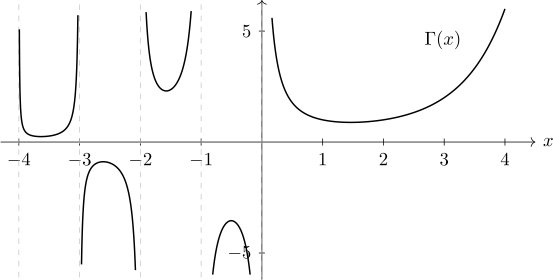
Theorem 2.1.7 (Gamma Function for Negative Values). We can use the property \[\Gamma (x) = \frac {1}{x}\, \Gamma (x + 1)\] to deduce the Gamma function for \(x\leq 0\). If \(x + 1 > 0,\) \[\Gamma (x) = \frac {1}{x}\, \Gamma (x + 1)\] is well defined for \(x\neq 0\). So \(\Gamma (x)\) is also defined for \(x > -1\), \(\, x\neq 0.\)
Note 2.1.8. The functional equation \(\Gamma (x+1)=x\,\Gamma (x)\) is the defining property of the gamma function, not merely one of its identities. Read forwards with \(\Gamma (1)=1\) it gives \(\Gamma (n+1)=n!\), so the function interpolates the factorial. Read backwards, as \(\Gamma (x)=\Gamma (x+1)/x\), it defines \(\Gamma \) for \(x<0\) where the defining integral diverges, and it is this rearrangement that extends the function to the whole plane except the non-positive integers. The poles there are visible in the same formula: as \(x\to 0\) the right-hand side has \(\Gamma (1)=1\) over a vanishing denominator.
Example 2.1.9. \[\Gamma \left (-\frac {1}{2}\right ) = \frac {1}{-\frac {1}{2}}\, \sqrt {-\frac {1}{2} + 1} = -2\sqrt {\pi }.\]
Next suppose that \(-2 < x < -1\), then \(-1 < x + 1 < 0\), and so that \(\Gamma (x + 1)\) is now already defined.
Example 2.1.10. \[\Gamma \left (-\frac {3}{2}\right ) = \frac {1}{-3/2}\Gamma \left (-\frac {1}{2}\right ) = -\frac {2}{3}(-2\sqrt {\pi }) = \frac {4}{3}\sqrt {\pi }.\]
Proceeding recursively, we obtain the definition of \(\Gamma (x)\) for all \(x\) except \(0, \, -1, \, -2, \, -3, \, \cdots \), and son one \[\Gamma (x) = \frac {1}{x}\, \Gamma (x + 1)\] for other values of \(x\).
Proof. \[\Gamma (x) = \int _0^{\infty }t^{x - 1}\, e^{-t}\, dt > \int _0^{1}t^{x-1}\, e^{-t}\, dt\] (since the integrand is positive). \[ > e^{-1} \int _0^1t^{x-1}\, dt = \frac {1}{xe}.\] Now as \(x\rightarrow 0^+\), \(\frac {1}{x}\rightarrow \pm \infty \), so that also \(\Gamma (x) \rightarrow +\infty \) as \(x\rightarrow 0^+.\)
If \(x \rightarrow 0^-\), \(\, \frac {1}{x}\rightarrow -\infty \). So \[\Gamma (x) = \frac {1}{x}\, \Gamma (x + 1) \rightarrow -\infty \] As \(x\rightarrow 0\), \(\, \Gamma (x + 1) \rightarrow \Gamma (1) = 1.\)
Now \begin {align*} \Gamma (-1) & = \frac {1}{-1}\, \Gamma (0) = \infty \\\\ \Gamma (-2) & = \frac {1}{-2}\Gamma (-2 + 1) = \frac {1}{-2}\Gamma (-1) = \infty \hspace {0.3cm} \text {e.t.c} \end {align*} □
With what we have above about \(\Gamma (x)\) one can sketch the graph of the Gamma function.
Example 2.1.13. Calculate in terms of \(\sqrt {\pi }\) the following
- (a).
- \(\displaystyle {\int _0^{\infty } x^2 \, e^{-x^2}\, dx}\)
- (b).
- \(\displaystyle {\int _0^{\infty } x^4\, e^{-x^2}\, dx}\)
Working. By theorem 2.3 \[\Gamma (x) = 2\int _0^{\infty } e^{-t^2}\, t^{2x - 1}\, dt.\]
- (a).
- Let \(2 = 2u -1 \, \implies \, u = \frac {3}{2}\). Therefore \begin {align*} \int _0^{\infty } x^2\, e^{-x^2}\, dx & = \int _0^{\infty } x^{2u-1}\, e^{-x^2}\, dx\\ & = \frac {1}{2}\, \Gamma (u)\\ & = \frac {1}{2}\, \Gamma \left (\frac {3}{2}\right )\\ & = \frac {1}{2}\, \cdot \, \frac {1}{2}\, \Gamma \left (\frac {1}{2}\right )\\ & = \frac {1}{4}\, \sqrt {\pi }. \end {align*}
- (b).
- Let \(4 = 2u-1\, \implies \, u = \frac {5}{2}.\) \begin {align*} \int _0^{\infty }x^4\, e^{-x^2}\, dx & = \int _0^{\infty } x^{2u-1}\, e^{-x^2}\, dx\\ & = \frac {1}{2}\, \Gamma \left (\frac {5}{2}\right )\\ & = \frac {1}{2}\, \cdot \, \frac {3}{2}\, \Gamma \left (\frac {3}{2}\right )\\ & = \frac {1}{2}\, \cdot \, \frac {3}{2}\, \cdot \, \frac {1}{2}\, \Gamma \left (\frac {1}{2}\right )\\ & = \frac {3}{8}\, \sqrt {\pi }. \end {align*}
- (a).
- If \(a > 0\), show that
\[\int ^{\infty }_0x^{n-1}\, e^{-\alpha x}\, dx = \frac {1}{\alpha ^n}\, \Gamma (n).\]
Working. We know that \[\Gamma (t) = \int ^{\infty }_0x^{t-1}\, e^{-x}\, dx.\] Let \(y = \alpha x\), \(\,\, dy = \alpha dx\). Thus \begin {align*} \int _0^{\infty } x^{n-1}\, e^{-\alpha x}\, dx & = \int _0^{\infty }\left (\frac {y}{\alpha }\right )^{n-1}\, e^{-y}\, \frac {dy}{\alpha }\\ & = \frac {1}{\alpha ^n}\int _0^{\infty }y^{n-1}\, e^{-y}\, dy\\ & = \frac {1}{\alpha ^n}\, \Gamma (n), \end {align*}
hence shown. □
- (b).
- Calculate in terms of \(\sqrt {\pi }\) the values of
- (i).
- \(\displaystyle {\int ^{\infty }_0x^{-\frac {1}{2}}\, e^{-2x}\, dx}\)
- (ii).
- \(\displaystyle {\int _0^{\infty }x^{\frac {3}{2}}\, e^{-4x}\, dx}\)
Working. By theorem 2.3, \[\Gamma (y) = 2\int _0^{\infty } e^{-t^2}\, t^{2y-1}\, dt.\]
- (i).
- Let \(2x = u^2\, \implies \, 2dx = 2udu\). Thus \begin {align*} \int _0^{\infty }x^{-\frac {1}{2}}\, e^{-2x}\, dx & = \int _0^{\infty } \left (\frac {u^2}{2}\right )^{-\frac {1}{2}}\, e^{-u^2}\, udu\\ & = \sqrt {2}\int _0^{\infty } u^{-1}\, u\, e^{-u^2}\, du\\ & = \sqrt {2}\int _0^{\infty } e^{-u^2}\, du\\ & = \sqrt {2}\int _0^{\infty } u^0\, e^{-u^2}\, du\, , \hspace {0.4cm}\text {set}\,\,\, 0 = 2y - 1\, \implies \, y = \frac {1}{2}\\ & = \sqrt {2}\, \cdot \, \frac {1}{2}\, \Gamma \left (\frac {1}{2}\right )\\ & = \frac {\sqrt {2}}{2}\, \sqrt {\pi }\\ & = \frac {\sqrt {2\pi }}{2}. \end {align*}
- (ii).
- Let \(4x = u^2\, \implies \, 2dx = udu\), so \begin {align*} \int ^{\infty }_0 x^{\frac {3}{2}}\, e^{-4x}\, dx & = \int ^{\infty }_0\left (\frac {u^2}{4}\right )^{\frac {3}{2}}\, e^{-u^2}\, \frac {u\, du}{2}\\ & = \int _0^{\infty } \frac {u^4}{16}\, e^{-u^2}\, du\\ & = \frac {1}{16}\int _0^{\infty } u^4\, e^{-u^2}\, du\\ & = \frac {1}{16}\int _0^{\infty }u^{2y-1}\, e^{-u^2}\, du\hspace {0.5cm} \text {letting}\,\, 4 = 2y - 1 \, \implies \, y = \frac {5}{2}\\ & = \frac {1}{16}\, \cdot \, \frac {1}{2}\Gamma \left (\frac {5}{2}\right ) \end {align*}
- (c).
- Derive the formula
\[\Gamma (x) = \int ^1_0\left [\log \left (\frac {1}{u}\right )\right ]^{x-1}\, du\]
by putting \(u = e^{-t}\) in definition 2.1. Then set \(u = v^{\alpha }\), \(\alpha >0\). Find the value of
\[\int _0^1\left [\log \left (\frac {1}{v^{\alpha }}\right )\right ]^{x-1}\, v^{\alpha - 1} dv\]
where \(x > 0\).
Working. Let \(u = e^{-t}, \hspace {0.3cm} du = -e^{-t}\, dt\) then \[\Gamma (x) = \int _0^{\infty } t^{x-1}\, e^{-t}\, dt.\] Notice; \[e^t = \frac {1}{u}\, \implies \, t = \log \left (\frac {1}{u}\right )\] \begin {align*} \Gamma (x) & = \int _1^0 \left (\log \frac {1}{u}\right )^{x-1}\, u\, \left (-\frac {du}{u}\right )\\ & = -\int ^0_1\left [\log \left (\frac {1}{u}\right )\right ]^{x-1}\, du\\ & = \int ^1_0\left [\log \left (\frac {1}{u}\right )\right ]^{x-1}\, du. \end {align*}
Next, let \(u = v^{\alpha }, \, \, du = \alpha \, v^{\alpha -1}, \) and \(v = u^{\frac {1}{\alpha }}\). Thus \begin {align*} \int ^1_0\left [\log \left (\frac {1}{v}\right )\right ]^{x-1} \, v^{\alpha - 1}\, dv & = \int _0^1\left [\log \left (\frac {1}{u^{\frac {1}{\alpha }}}\right )\right ]^{x - 1}\, \frac {du}{\alpha }\\ & = \frac {1}{\alpha }\int _0^1\left [\log \left (\frac {1}{u}\right )^{\frac {1}{\alpha }}\right ]^{x-1}\, du\\ & = \frac {1}{\alpha }\int _0^1\left [\frac {1}{\alpha }\, \log \frac {1}{u}\right ]^{x-1}\, du\, , \hspace {0.3cm} \text {by property of logs}\\ & = \frac {1}{\alpha ^x}\int _0^1\left [\log \left (\frac {1}{u}\right )\right ]^{x-1}\, du\\ & = \frac {1}{\alpha ^x}\, \Gamma (x),\,\hspace {0.3cm}\text {by part earlier past}. \end {align*} □
- (d).
- Utilise the results of part (c) above to show that
- (i).
- \(\displaystyle {\int _0^1 \left [\frac {\log \frac {1}{t}}{t}\right ]^{\frac {1}{2}}\, dt = \sqrt {2\pi }}.\)
- (ii).
- \(\displaystyle {\int _0^1\left [\frac {t}{\log \left (\frac {1}{t}\right )}\right ]^{\frac {1}{2}}\, dt = \sqrt {\frac {2\pi }{3}}}.\)
Working.
- (i).
- \(\begin {aligned}[t] \int _0^1\left [\frac {\log \frac {1}{t}}{t}\right ]^{\frac {1}{2}}\, dt & = \int _0^1\left [\log \left (\frac {1}{t}\right )\right ]^{\frac {1}{2}}\, t^{-\frac {1}{2}}\, dt\\ & = \int _0^1\left [\log \left (\frac {1}{t}\right )\right ]^{x - 1}\ t^{\alpha - 1}\, dt\, , \hspace {0.5cm} \text {letting}\hspace {0.2cm} x = \frac {3}{2}, \, \alpha = \frac {1}{2}\\ & = \frac {1}{\alpha ^x}\, \Gamma (x) \hspace {0.5cm} \text {by part (c)}\\ & = \frac {1}{\left (\frac {1}{2}\right )^{\frac {3}{2}}}\, \Gamma \left (\frac {3}{2}\right )\\ & = 2^{\frac {3}{2}}\, \cdot \, \frac {1}{2}\, \Gamma \left (\frac {1}{2}\right )\\ & = 2\sqrt {2}\, \cdot \, \frac {1}{2}\sqrt {\pi }\, , \hspace {0.5cm} \text {since}\hspace {0.3cm} 2^{\frac {3}{2}} = (\sqrt {2})^3 = 2\sqrt {2}\\ & = \sqrt {2}\, \cdot \, \sqrt {\pi }\\ & = \sqrt {2\pi }. \end {aligned}\)
- (ii).
- \(\begin {aligned}[t] \int _0^1 \left [\frac {t}{\log \left (\frac {1}{t}\right )}\right ]^{\frac {1}{2}}\, dt & = \int _0^1\left [\log \left (\frac {1}{t}\right )\right ]t^{\frac {1}{2}}\, dt \\ & = \int ^1_0\left [\log \left (\frac {1}{t}\right )\right ]^{x-1}\, t^{\alpha - 1}\, dt,\hspace {0.5cm} \text {letting}\hspace {0.3cm} x - 1 = -\frac {1}{2}, \hspace {0.2cm} \alpha - 1 = \frac {1}{2}\\ & = \frac {1}{\alpha ^x}\, \Gamma (x)\\ & = \frac {1}{\left (\frac {3}{2}\right )^{\frac {1}{2}}}\, \Gamma \left (\frac {1}{2}\right )\\ & = \sqrt {\frac {2}{3}}\, \sqrt {\pi }\\ & = \sqrt {\frac {2\pi }{3}}. \end {aligned}\)
- (e).
- Use \(\Gamma (x + 1) = x\, \Gamma (x)\) to show that if \(n = 1, \, 2, \, 3, \, \cdots \)
- (i).
- \(\displaystyle {\Gamma \left (n + \frac {1}{2}\right ) = \frac {1\, \cdot \, 3\, \cdot \, \cdot \, 7\, \cdots \, (2n-1)\, \sqrt {\pi }}{2^n}}\)
- (ii).
- \(\displaystyle {\sqrt {\pi }\, \sqrt {(2n + 1)} = 2^{2n}\, \Gamma \left (n + \frac {1}{2}\right )\, \Gamma (n+1)}\)
Working. Using \(\Gamma (x + 1) = x\Gamma (x)\), get
- (i).
- \(\begin {aligned}[t] \Gamma \left (n + \frac {1}{2}\right ) & = \left (n - \frac {1}{2}\right )\, \Gamma \left (n-\frac {1}{2}\right )\\ & = \left (n - \frac {1}{2}\right )\, \left (n-\frac {3}{2}\right )\, \Gamma \left (n-\frac {3}{2}\right )\\ & = \left (n-\frac {1}{2}\right )\, \left (n - \frac {3}{2}\right )\, \left (n-\frac {5}{2}\right )\, \left (n-\frac {7}{2}\right ) \, \cdots \, \left (n - \frac {2n-1}{2}\right )\, \Gamma \left (\frac {1}{2}\right )\\ & = \left (n-\frac {1}{2}\right )\, \left (n - \frac {3}{2}\right )\, \left (n-\frac {5}{2}\right )\, \left (n-\frac {7}{2}\right ) \, \cdots \, \frac {1}{2}\, \Gamma \left (\frac {1}{2}\right )\\ \end {aligned}\)
(notice that the general term is \(\left (n-\frac {2k + 1}{2}\right )\) since \(2k + 1\) is the general term of old numbers) \[\Gamma \left (n + \frac {1}{2}\right ) = \frac {1\, \cdot \, 3\, \cdot \, \cdot \, 7\, \cdots \, (2n-1)}{2^n}\, \sqrt {\pi }.\]
- (ii).
- \(\begin {aligned}[t] \sqrt {\pi }\, \Gamma \left (2n + 1\right ) & = \frac {2^n\, \Gamma \left (n + \frac {1}{2}\right )\, \Gamma (2n + 1)}{1\cdot 3\cdot 5\, \cdots \, (2n-1)}\hspace {0.4cm}\text {by (i)}\\ & = \frac {2^n\, \Gamma \left (n + \frac {1}{2}\right )\, (2n)!}{1\cdot 3\cdot 5\cdot \cdots (2n-1)!}\, , \, \hspace {0.3cm} \Gamma (2n +1) = (2n)!\\ & = \frac {\left [(2n)\, (2n-2)\, (2n-4)\, (2n-6)\, \cdots \, 2\, \cdot \, 1\right ] 2^n\, \Gamma \left (n+\frac {1}{2}\right )}{1\cdot 3\cdot 5\, \cdots \, (2n-1)} \\ & = [2(n)\cdot 2(n-1)\cdot 2(n-2)\cdot 2(n-3)\, \cdots \, 2\, \cdot \, 1]\, 2^n\, \Gamma \left (n+ \frac {1}{2}\right )\\ & = 2^n\, \left [n\, (n-1)\, (n-2)\, \cdots \, 2\, \cdot \, 1\right ]\, \cdot \, 2^{2n}\, \Gamma \left (n + \frac {1}{2}\right )\\ & = 2^{2n}\, n!\, \Gamma \left (n + \frac {1}{2}\right )\\ & = 2^{2n}\, \Gamma (n+1)\, \Gamma \left (n + \frac {1}{2}\right ). \end {aligned}\)
- (f).
- (Exercise) \[\sqrt {\pi }\Gamma (2n) = 2^{2n -1}\, \Gamma (n)\, \Gamma \left (n + \frac {1}{2}\right ).\] Hint: let \(2n + 1 = 2k\).
- (g).
- Express in terms of Gamma function, using theorem 2.4
- (i).
- \(\displaystyle {\int ^{\pi }_0\sqrt {\tan \theta }\, d\theta \approx \frac {1}{2}\, \Gamma \left (\frac {1}{4}\right )\, \Gamma \left (\frac {3}{4}\right ).}\)
- (ii).
- \(\displaystyle {\int _0^{\infty } t^{-\frac {3}{2}} (1 - e^{-t})\, dt}\hspace {0.5cm}\) first integrate by parts.
- (iii).
- \(\displaystyle {\int _0^{\frac {\pi }{2}}\tan ^n\theta \, d\theta = \frac {1}{2}\, \Gamma \left (\frac {n +1}{2}\right )\, \Gamma \left (\frac {1 -n}{2}\right )}\hspace {0.3cm}\) for \(\, \hspace {0.2cm} |n| < 1.\)
- (iv).
- Evaluate \(\, \Gamma \left (-\frac {1}{2}\right )\, ,\hspace {0.3cm} \Gamma \left (-\frac {7}{2}\right ).\)
Questions on this section
Stuck on something here? Ask below and it stays attached to this topic.