4.6 Bessel’s Equation
Every family met so far has been polynomial. Bessel’s equation is the point at which that stops, and it is worth seeing why, because the reason is structural rather than accidental.
Definition 4.6.1 (Bessel’s equation). For a parameter \(\nu \geq 0\), Bessel’s equation of order \(\nu \) is \begin {equation} x^{2}y'' + x\,y' + \left (x^{2}-\nu ^{2}\right )y = 0 . \label {eq:bessel} \end {equation}
Theorem 4.6.2 (Sturm–Liouville form). Equation (4.3), rescaled as \(x^{2}y''+xy'+\left (\lambda x^{2}-\nu ^{2}\right )y=0\), is the Sturm–Liouville problem \[\left (x\,y'\right )' + \left (-\frac {\nu ^{2}}{x} + \lambda \,x\right )y = 0\] on \([0,a]\), with \(p(x)=x\), \(q(x)=-\nu ^{2}/x\) and weight \(w(x)=x\).
Proof. Apply Theorem 4.2.1 with \(a_2 = x^{2}\) and \(a_1 = x\). Then \(a_1/a_2 = 1/x\), whose integral is \(\ln x\), so \(p(x)=x\) and the integrating factor is \(\mu = p/a_2 = 1/x\). Multiplying (4.3) through by \(1/x\) gives the stated form, with weight \(w=\mu \,x^{2}/x = x\). □
Note 4.6.3. The weight \(w(x)=x\) is the reason Bessel functions appear wherever a problem is posed on a disc. In polar coordinates the area element is \(r\,dr\,d\theta \), and the \(r\) in that element is exactly this weight; orthogonality with respect to it is orthogonality over the disc. The same computation on an interval of the line produced weight \(1\) and the trigonometric system of Chapter 5. The geometry chooses the special function.
Note 4.6.4. This is a singular Sturm–Liouville problem: \(p(0)=0\) and \(w(0)=0\), and \(q\) is unbounded at the origin. As in Section 4.1 the boundary condition at the singular end is replaced by the requirement that the solution remain bounded, and that requirement is what selects one of the two independent solutions.
Solution by the method of Frobenius
Because \(x=0\) is a regular singular point, solutions are sought as \(y = x^{r}\sum ^{\infty }_{k=0}a_k x^{k}\) with \(a_0\neq 0\). Substituting into (4.3) and collecting the lowest power gives the indicial equation \(r^{2}-\nu ^{2}=0\), so \(r=\pm \nu \). The recurrence for the coefficients is \[a_k = -\frac {a_{k-2}}{k\left (k+2r\right )},\] which annihilates every odd coefficient and, with \(r=\nu \) and the conventional normalisation \(a_0 = 1/\left [2^{\nu }\Gamma (\nu +1)\right ]\), yields the following.
Definition 4.6.5 (Bessel function of the first kind). \[J_{\nu }(x) = \sum ^{\infty }_{k=0} \frac {(-1)^{k}}{k!\,\Gamma (k+\nu +1)}\left (\frac {x}{2}\right )^{2k+\nu }.\]
Note 4.6.6. The gamma function of Chapter 2 is doing real work here, and this is the first place in these notes where it is indispensable rather than convenient. For integer \(\nu =n\) the coefficient denominator is \(k!\,(k+n)!\) and the series could be written with factorials alone. For non-integer \(\nu \) — the half-integer case below, for instance — there is no factorial to write, and only the gamma function makes the definition possible at all.
Theorem 4.6.7 (Second solution). For non-integer \(\nu \), \(J_{\nu }\) and \(J_{-\nu }\) are linearly independent and the general solution of (4.3) is \(c_1J_{\nu }+c_2J_{-\nu }\). For integer \(\nu = n\) they are not: \(J_{-n}(x) = (-1)^{n}J_{n}(x)\). A second independent solution valid for all \(\nu \) is the Bessel function of the second kind \[Y_{\nu }(x) = \frac {J_{\nu }(x)\cos \nu \pi - J_{-\nu }(x)}{\sin \nu \pi },\] the integer case being defined by the limit \(\nu \to n\).
Note 4.6.8. \(Y_{\nu }(x)\to -\infty \) as \(x\to 0^{+}\) for every \(\nu \). On a disc, or anywhere the origin is part of the domain, boundedness therefore eliminates \(Y_{\nu }\) entirely and leaves \(J_{\nu }\) — which is the singular boundary condition of Section 4.1 doing its work in a concrete case. On an annulus, where the origin is excluded, both solutions survive and both are needed.
Properties
Theorem 4.6.9 (Recurrence relations). \[J_{\nu -1}(x)+J_{\nu +1}(x) = \frac {2\nu }{x}J_{\nu }(x), \qquad J_{\nu -1}(x)-J_{\nu +1}(x) = 2J_{\nu }'(x),\] and consequently \[\frac {d}{dx}\left [x^{\nu }J_{\nu }(x)\right ] = x^{\nu }J_{\nu -1}(x), \qquad \frac {d}{dx}\left [x^{-\nu }J_{\nu }(x)\right ] = -x^{-\nu }J_{\nu +1}(x).\]
Theorem 4.6.10 (Generating function, integer order). \[\exp \left [\frac {x}{2}\left (t-\frac {1}{t}\right )\right ] = \sum ^{\infty }_{n=-\infty }J_{n}(x)\,t^{n},\qquad t\neq 0 .\]
Note 4.6.11. Compare this with the generating functions of Chapter 3 — \((1-2xt+t^{2})^{-1/2}\) for Legendre, \(\exp \left (xt-t^{2}/2\right )\) for Hermite. Each family has one, each is proved the same way, and each yields the recurrence relations by differentiating with respect to \(t\) and comparing coefficients. The technique is the same; only the function changes.
Example 4.6.12 (Half-integer order). For \(\nu = \tfrac 12\) the series can be summed in closed form. Using \(\Gamma \left (k+\tfrac 32\right ) = \frac {(2k+1)!\sqrt {\pi }}{4^{k}\,k!\,2\,(2k+1)}\) and collecting terms, \[J_{1/2}(x) = \sqrt {\frac {2}{\pi x}}\,\sin x, \qquad J_{-1/2}(x) = \sqrt {\frac {2}{\pi x}}\,\cos x .\] These are the only orders at which a Bessel function is elementary, and they are the reason spherical problems reduce to trigonometry while cylindrical ones do not.
Theorem 4.6.13 (Orthogonality). Let \(\alpha _{\nu ,1}<\alpha _{\nu ,2}<\cdots \) be the positive zeros of \(J_{\nu }\). Then \[\int ^{a}_{0}J_{\nu }\!\left (\frac {\alpha _{\nu ,m}x}{a}\right ) J_{\nu }\!\left (\frac {\alpha _{\nu ,n}x}{a}\right )x\,dx = 0, \qquad m\neq n,\] and for \(m=n\) the integral equals \(\tfrac {a^{2}}{2}\left [J_{\nu +1}(\alpha _{\nu ,n})\right ]^{2}\).
Proof. This is Theorem 4.3.2 applied to the Sturm–Liouville problem above, with weight \(w(x)=x\) and eigenvalues \(\lambda _n = \left (\alpha _{\nu ,n}/a\right )^{2}\). The boundary term (4.2) vanishes at \(x=0\) because \(p(0)=0\), and at \(x=a\) because each eigenfunction vanishes there by the choice of the \(\alpha _{\nu ,n}\). □
Note 4.6.14. Nothing in that proof was specific to Bessel functions. It is the same argument that gave the orthogonality of the Legendre polynomials and of the trigonometric system, and it is the last confirmation of the claim made at the start of Chapter 4: one theorem, many instances. The corresponding expansion \[f(x) = \sum ^{\infty }_{n=1}c_n J_{\nu }\!\left (\frac {\alpha _{\nu ,n}x}{a}\right ), \qquad c_n = \frac {2}{a^{2}J_{\nu +1}^{2}(\alpha _{\nu ,n})} \int ^{a}_{0}f(x)J_{\nu }\!\left (\frac {\alpha _{\nu ,n}x}{a}\right )x\,dx,\] is the Fourier–Bessel series, and it stands to the disc exactly as the Fourier series of Chapter 5 stands to the interval.
Modified Bessel functions
Replacing \(x\) by \(ix\) in (4.3) gives \[x^{2}y''+x\,y'-\left (x^{2}+\nu ^{2}\right )y = 0,\] the modified Bessel equation, whose solutions are \[I_{\nu }(x) = i^{-\nu }J_{\nu }(ix) = \sum ^{\infty }_{k=0}\frac {1}{k!\,\Gamma (k+\nu +1)}\left (\frac {x}{2}\right )^{2k+\nu }, \qquad K_{\nu }(x) = \frac {\pi }{2}\,\frac {I_{-\nu }(x)-I_{\nu }(x)}{\sin \nu \pi }.\]
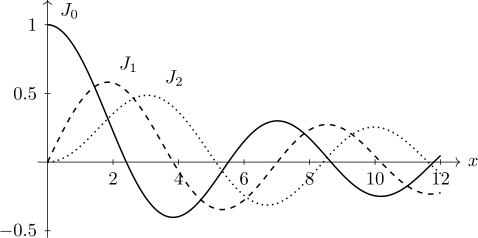
Note 4.6.15. The sign change removes the oscillation. \(J_{\nu }\) has infinitely many zeros and decays like \(x^{-1/2}\); \(I_{\nu }\) has none on \((0,\infty )\) and grows like \(e^{x}\), while \(K_{\nu }\) decays like \(e^{-x}\). The distinction is the same one that separates \(\sin x\) from \(\sinh x\), and it arises in the same way — from the sign of the term that carries the eigenvalue.
4.6.1 Practice Problems
Problem 4.6.1. Carry out the Frobenius substitution in (4.3) in full: derive the indicial equation, the recurrence for \(a_k\), and show that all odd coefficients vanish. Where to start: substitute \(y=\sum a_k x^{k+r}\) and collect the coefficient of \(x^{k+r}\).
Problem 4.6.2. Show that \(J_{1/2}(x) = \sqrt {2/(\pi x)}\,\sin x\) directly from the series. Where to start: use the duplication formula, Theorem 2.2.5, to simplify \(\Gamma \left (k+\tfrac 32\right )\).
Problem 4.6.3. Prove that \(\dfrac {d}{dx}\left [x^{\nu }J_{\nu }(x)\right ] = x^{\nu }J_{\nu -1}(x)\) by differentiating the series term by term, and deduce \(J_0'(x) = -J_1(x)\).
Problem 4.6.4. Show that between any two consecutive positive zeros of \(J_{\nu }\) there is exactly one zero of \(J_{\nu +1}\). Where to start: apply Rolle’s theorem to \(x^{-\nu }J_{\nu }(x)\) using the second derivative identity above.
Problem 4.6.5. Verify that the boundary term (4.2) vanishes at both ends for the Bessel problem on \([0,a]\) with \(y(a)=0\), and explain why no condition need be imposed at \(x=0\) beyond boundedness.
Problem 4.6.6. A circular drum of radius \(a\) is fixed at its rim. Separating variables in the wave equation on the disc leads to Bessel’s equation of integer order. Explain why the admissible frequencies are proportional to the zeros \(\alpha _{n,m}\) of \(J_n\), and why — unlike a vibrating string — they are not integer multiples of a fundamental. Where to start: the zeros of \(J_n\) are not equally spaced, whereas those of \(\sin \) are. This is why a drum sounds unpitched and a string does not.
Questions on this section
Stuck on something here? Ask below and it stays attached to this topic.