Chapter 5
Fourier Series Analysis
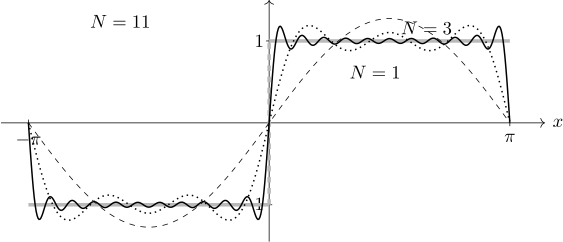
Another way of representing functions in terms of series is by representing as series of sines and cosines which we call Fourier series. Applications of Fourier series range from solutions of PDE’s, time series analysis, engineering to many other applications.
5.1 The Series and Its Coefficients
5.2 Periodicity and Periodic Extension
5.3 Worked Examples
5.4 The Dirichlet Kernel
5.5 Convergence of Fourier Series
5.6 Symmetry and Half-Range Expansions
5.7 Parseval’s Identity
5.8 The Complex Form
5.9 From Fourier Series to the Fourier Transform
5.10 Practice Problems
5.2 Periodicity and Periodic Extension
5.3 Worked Examples
5.4 The Dirichlet Kernel
5.5 Convergence of Fourier Series
5.6 Symmetry and Half-Range Expansions
5.7 Parseval’s Identity
5.8 The Complex Form
5.9 From Fourier Series to the Fourier Transform
5.10 Practice Problems