1.3 Distributions of a Single Order Statistic
Let \(X_1, X_2, \cdots X_n\) be a random sample of size \(n\) from a distribution with Cdf \(P(x)\) and \(F_r(x)\) denote the Cdf of the \(r^{\text {th}}\) order statistic \((r = 1, 2, \cdots , n)\). We assume that the distribution from where the sample was drawn is continuous. \begin {align*} F_r(x) & = P_{pro}\left (X_{(r)} \leq x\right )\\ & = P_{pro}\left (\text {at least}\, r\, \text {of the}\, X_i's\, \text {are less tha or equal to }\, x\right )\\ & = \sum ^n_{i = r} \binom {n}{i}\, \left [P(x)\right ]^i\,\left [1 - P(x)\right ]^{n - i} \hspace {0.5cm}\cdots \hspace {0.3cm} 1.3.1 \end {align*}
Special case
\[\text {if}\hspace {0.3cm} r = 1, \hspace {0.5cm} F_1(x) = \sum ^n_{i = 1} \binom {n}{i}\, \left [P(x)\right ]^i\, \left [1 - P(x)\right ]^{n - i} = 1 - \left [1 - P(x)\right ]^n\hspace {0.5cm} \cdots \hspace {0.3cm} 1.3.2\]
\(\text {if}\hspace {0.5cm} r = n, \hspace {0.5cm} F_n(x) = \left [P(x)\right ]^n\hspace {0.5cm}\cdots \hspace {0.3cm} 1.3.3\)
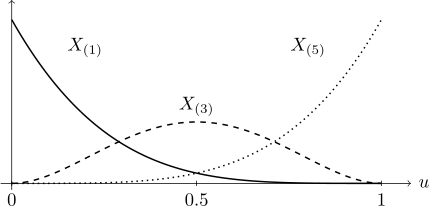
From the well-known relation between Binomial sums and the incomplete beta function \[F_r(x) = I_{P(x)}(r\,, \, n - r + 1) = \frac {1}{B(r\, , \, n - r + 1)}\, \int _0^{P(x)}t^{r - 1}\, (1 - t)^{n - r}\, dt\hspace {0.5cm}\cdots \hspace {0.3cm}1.3.4\] Thus the probability density function for the \(r^{\text {th}}\) order-statistic \begin {align*} f_r(x) & = \frac {\partial }{\partial x}\,F_r(x)\\ & = \frac {1}{B(r\, , \, n - r + 1)}\, \frac {\partial }{\partial x}\int ^{P(x)}_0t^{r - 1}\, (1 - t)^{n - r}\, dt\\\\ & = \frac {\left (P(x)\right )^{r - 1}\, \left (1 - P(x)\right )^{n - r}}{B(r\, , \, n - r + 1)}\, \frac {d}{dx}\, P(x)\\\\ f(x) & = \frac {p(x)\, \left [P(x)\right ]^{r -1}\, \left [1 - P(x)\right ]^{n - r}}{B(r\, , \, n - r + 1)}. \end {align*}
\[B(r\, , \, n - r + 1) = \frac {\Gamma (r)\, \Gamma (n - r + 1)}{\Gamma (n + 1)} = \frac {(r - 1)!\, (n - r)!}{n!}.\]
\[\therefore \,\, f_r(x) = \frac {n!}{(r - 1)!\, (n - r)!}\, p(x)\, \left [P(x)\right ]^{r - 1}\, \left [1 - P(x)\right ]^{n - r}\hspace {0.5cm}\cdots \hspace {0.3cm} 1.3.5.\]
\[r = 1, \hspace {0.5cm} f_1(x) = n\, p(x)\, \left [1 - P(x)\right ]^{n - 1}\]
\[r = n, \hspace {0.5cm} f_n(x) = n\, p(x)\, \left [P(x)\right ]^{n - 1}\]
Questions on this section
Stuck on something here? Ask below and it stays attached to this topic.