1.2 Open Sets, Neighbourhoods and Interior Points
In this section we will discuss subsets of metric spaces that play an important role in further
development of several aspects of the theory of metric spaces.
Definition 1.2.1. Let (X,d) be a metric space, \(x_0\) a point in X and \(r>0\) a real number. Then
- i
- the open ball of radius r centered at \(x_0\) is the set \[B(x_0,r)=\{x\in X:d(x,x_0)<r\}\]
- ii
- the closed ball of radius r and centered at \(x_0\) is the set \[B[x_0,r]=\{x\in X:d(x,x_0)\leq r\}\]
- iii
- the sphere of radius r centered at \(x_0\) is the set
\[S(x_0,r)=\{x\in X:d(x,x_0)=r\}\]
Note. \(S(x_0,r)=B[x_0,r]-B(x_0,r)\)
Example 1.2.2. Consider the metric space \((\mathbb {R},d)\) where d is the usual metric on \(\mathbb {R}\). Then every open
interval is an open ball and every closed interval is a closed ball. Moreover, any two distinct
points \(a,b\in \mathbb {R}\) determine a sphere.
Proof. If we take \(x_0=\dfrac {a+b}{2}\) and \(r=\dfrac {|a-b|}{2}\), then the open ball interval (a,b) is the open ball \(B(x_0,r)\) and the closed interval
\([a,b]\) is the closed ball \(B[x_0,r]\).
Furthermore, if a and b are distinct real numbers, we obtain the sphere \(S(x_0,r)=\{x\in \mathbb {R}:|x-y|=r\}=\{a,b\}\).
□
Example 1.2.3. Consider \(\mathbb {R}^2\), with the metrics, \(d_1(x,y)=|x_1-y_1|+|x_2-y_2|\),
\(d_2(x,y)=\sqrt {(x_1-y_1)^2+(x_2-y_2)^2}\) and \(d_3(x,y)=\max \{|x_1-y_1|,|x_2-y_2|\}\). Find the open ball of radius 1 centered at (0,0) with respect (i) \(d_1\), (ii) \(d_2\), (iii) \(d_3\).
Solution.
- i
- \begin {align*} B((0,0),1) &=\{(x_1,x_2)\in \mathbb {R}^2:d_1((0,0),(x_1,x_2))<1\}\\ &=\{(x_1,x_2)\in \mathbb {R}^2:|x_1|+|x_2|<1\} \end {align*}
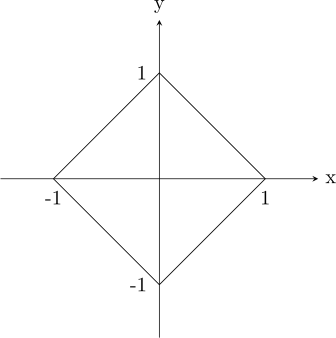
This set represents the interior of the region bounded by the lines \(x_1+x_2=1\), \(x_1-x_2=1\), \(-x_1+x_2=1\) and \(-x_1-x_2=1\)
- ii
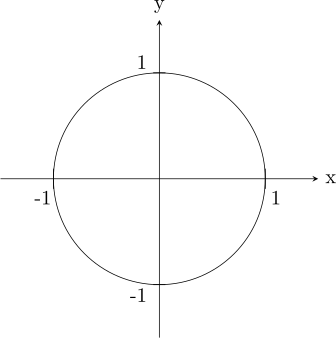
- \begin {align*} B((0,0),1) &=\{(x_1,x_2)\in \mathbb {R}^2:d_2((x_1,x_2),(0,0))<1\}\\ &=\{(x_1,x_2)\in \mathbb {R}^2:\sqrt {x_1^2+x^2_2}<1\} \end {align*}
This represents the interior of the circle of radius 1 centered at the origin.
- iii
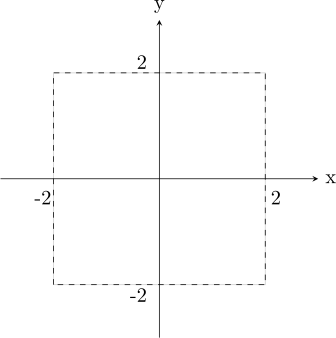
- \begin {align*} B((0,0),1) &=\{(x_1,x_2)\in \mathbb {R}^2:d_3((x_1,x_2),(0,0))<1\}\\ &=\{(x_1,x_2)\in \mathbb {R}^2:\max \{|x_1|,|x_2|<1\}\} \end {align*}
This represents the interior of the square of diameter 2 centered at the origin.
Definition 1.2.4. Let (X,d) be a metric space. A subset O of X is said to be an open set in X
if for every \(x\in O\), there is a real number \(r>0\) such that \(B(x,r)\subseteq O\).
Example 1.2.5. In the metric space \((\mathbb {R},d)\) where d is usual metric on \(\mathbb {R}\), all unions of open intervals
are open sets.
Proof. Let \(x\in A\), where A is a union of open intervals in \(\mathbb {R}\). Then X belongs to atleast one open
intervals. Since every open interval in \(\mathbb {R}\) is an open ball, it follows that A is an open set.
□
Theorem 1.2.6. If (X,d) is a metric space, then the union of any collection of open sets in X
is open and the intersection of any finite collection of open sets in X is open.
Proof. Let \(\{O_{\lambda }:\lambda \in \Omega \}\) be any family of open sets in X and let \(x\in O=\bigcup _{\lambda \in \Omega } O_{\lambda }\). Then \(x\in O_{\lambda }\), for at least one \(\lambda \in \Omega \). Since \(O_{\lambda }\) is open
in X, there is an open ball B(x,r) such that \(B(x,r)\subseteq O_{\lambda }\). Since \(O_{\lambda } \subseteq O\), it follows that \(B(x,r)\subseteq O\). Since x was an arbitrary
element of O, we obtain that O is an open set in X.
To prove the second part, suppose that \(O_1,O_2,...........,O_n\) is a finite
collection of open sets in X and \(O=\bigcap _{k=1}^{n} O_k\). If \(x\in O\), then \(x\in O_k\) for all \(k=1,2,...........n\). Since each \(O_k\) is an open set in X, there is an
open ball \(B(x,r_k)\) such that \(B(x,r_k)\subseteq O_k\) for all \(k=1,2,.........,n\). Let
\(r=\min \{r_1, r_2,............,r_n\}\). Then \(B(x,r)\subseteq B(x,r_k)\) for all \(k=1,2,.........,n\). It follows that \(B(x,r)\subseteq O_k\) for all \(k=1,2,..........,n\), so that \(B(x,r)\subseteq O\). Hence O is open in X.
□
Proposition 1.2.7. If \((X,d)\) is a metric space, then the sets \(\emptyset \) and X are both open in X.
Proof. To show that \(\emptyset \) is an open set in X, we need to show that every point in \(\emptyset \) is contained in
an open ball which is a subset of \(\emptyset \). But this holds vacuously since \(\emptyset \) has no elements.
To prove the second part, if \(x\in X\), then every open ball \(B(x,r)\) is a subset of X. Hence X is an open set.
□
Definition 1.2.8. Let \((X,d)\) be a metric space and \(x_0\in X\). A subset N of X is said to be a
neighbourhood of \(x_0\) if there is an open ball \(B(x_0,r)\) in X such that
\(B(x_0,r)\subseteq N\).
Proposition 1.2.9. If \((X,d)\) is a metric space, then a subset \(O\) of \(X\) is open in \(X\) if and only if \(O\) is a
neighbourhood of each of its points.
Proof. Suppose that \(O\) is an open set in \(X\) and \(x_0\in O\). Then there is a real number \(r>0\) such that \(B(x_0,r)\subseteq O\), so that \(O\)
is a neighbourhood of \(x_0\). Since \(x_0\) was an arbitrary point in \(O\), we have that \(O\) is a neighbourhood of
each of its points.
Conversely, suppose that \(O\) is a neighbourhood of each of its points. If \(x_0\in O\), then there is a real
number \(r>0\) such that \(B(x_0,r)\subseteq O\). Since \(x_0\) was an arbitrary point in \(O\), it follows that \(O\) is open in X.
□
Theorem 1.2.10. Suppose that \((X,d)\) is a metric space and \(x_0\in X\). Then the union of any collection of
neighbourhoods of \(x_0\) is also a neighbourhood of \(x_0\) and the intersection of any finite collection of
neighbourhoods of \(x_0\) is also a neighbourhood of \(x_0\).
Proof. Let \(\{N_{\lambda }:\lambda \in \Omega \}\) be a collection of neighbourhoods of \(x_0\) and let
\(N=\bigcup _{\lambda \in \Omega } N_{\lambda }\). Since \(N_{\lambda }\) is a neighbourhood of \(x_0\) for each \(\lambda \in \Omega \), then for each \(\lambda \), there exists an open ball \(B(x_0,r)\) in X such
that
\[x_0\in B(x_0,r_{\lambda })\subseteq N_{\lambda }\subseteq \bigcup _{\lambda \in \Omega } N_{\lambda }=N\]
This means that \(N\) is a neighbourhood of \(x_0\).
To prove the second part, suppose that \(N_1,N_2,.......,N_n\) is a finite collection of neighbourhoods of \(x_0\) and \(N=\bigcap ^{n}_{k=1} N_k\). Then
there exists open balls \(B(x_0,r_1), B(x_0,r_2),.......,B(x_0,r_n)\) such that \(B(x_0,r_k)\subseteq N_k\) for \(k=1,2,......,n\). Let \(r=\min \{r_1, r_2,.....,r_n\}\). Then \(B(x_0,r)\subseteq B(x_0,r_k)\) for \(k=1,2,.....,n\), so that \(x_0\in B(x_0,r)\subseteq \bigcap ^n_{k=1} N_k =N\). Hence N is a neighbourhood
of \(x_0\).
□
Definition 1.2.11. Let (X,d) be a metric space and A a subset of X. A point \(x_0\) in X is said to
be an interior point of A if A is a neighbourhood of \(x_0\). The set of all interior points of A, denoted
by Int(A), is called the interior of A.
Example 1.2.12. Consider the metric space \((\mathbb {R},d)\), where \(d\) is the usual metric on \(\mathbb {R}\). If \(A=[0,1)\) in \(\mathbb {R}\), then \(Int(A)=(0,1)\).
Proof. Let \(a\in [0,1)\). If \(a=0\), then there is no \(r>0\) such that \(B(a,r)\subseteq [0,1)\). Thus \(a\not \in Int(A)\). Suppose that \(a\neq 0\). Take \(r=\min \{\frac {a}{2},\frac {1-a}{2}\}\). Then \(B(a,r)\subseteq [0,1)\) and so \(a\in Int(A)\). Hence
\(Int(A)=(0,1)\).
□
Proposition 1.2.13. If \((X,d)\) is a metric space and \(A\) a subset of \(X\), then \(Int(A)\) is the largest open set
contained in \(A\).
Proof. We prove that every open set contained in \(A\) is contained in \(Int(A)\). To this end suppose that \(O\)
is an open set contained in \(A\). Then \(O\) is a neighbourhood of each of its points and since \(O\subseteq A\), we have
that \(A\) is a neighbourhood of each of the points of \(O\). This implies that \(O\subseteq Int(A)\).
□
Definition 1.2.14. Let \((X,d)\) be a metric space and \(A\) a subset of \(X\). A point \(x_0\) in \(A\) is said to be a
boundary point of \(A\) if every open ball centered at \(x_0\) contains points of both \(A\) and \(A^c\). The set of all
boundary points of \(A\) is denoted by \(bd(A)\) and is called the boundary of \(A\).
Example 1.2.15. Consider the metric space \((\mathbb {R},d)\) where \(d\) is the usual metric. Given the set \(A=(0,1]\), find \(bd(A)\).
Solution. If \(r>0\) is any real number, \(B(0,r)\) contains points in both \(A\) and \(A^c\). Therefore \(0\in bd(A)\). Similarly, \(1\in bd(A)\). Now
consider \(x\in A\) such that \(x\neq 0\) and \(x\neq 1\). Take \(r=\min \{\frac {x}{2},\frac {1-x}{2}\}\). Then \(B(x,r)\subseteq A\) and so x is not a boundary point of A. This means that
\(bd(A)=\{0,1\}\).
Note in the previous example that a point in the set \(A\) is either a boundary point or an interior
point of \(A\). The next result shows that this is true for every subset of a metric space.
Proposition 1.2.16. If \((X,d)\) is a metric space and \(A\) is a subset of \(X\), then \(A\subseteq Int(A)\cup bd(A)\).
Proof. Let \(x\in A\). If there is a real number \(r>0\) such that \(B(x,r)\subseteq A\), then \(x \)is an interior point of \(A\) and the result
holds. If there is no real number \(r>0\) such that \(B(x,r)\subseteq A\), then \(x\) is a boundary point of \(A\) and in this case the
result also holds.
□
Questions on this section
Stuck on something here? Ask below and it stays attached to this topic.