5.1 Partitions and the Riemann Sums
In the discussion of Riemann integration, we shall be working with a closed and bounded interval \(I = [a,b]\) and
unless otherwise stated, all functions will be assumed to be real-valued which are defined and bounded
on the interval \([a,b]\).
Definition 5.1.1. A partition \(P\) of \([a,b]\) is a finite set \(P = \big \{x_0,\, x_1,\, x_2,\, \cdots \cdots \cdots \, , \, x_n\big \}\) such that \[a = x_0 < x_1 < \cdots \cdots \cdots < x_{n - 1} < x_n = b\]
The points \(\,x_0,\, x_1,\, x_2,\, \cdots \cdots \cdots \, , \, x_n\, \) are called the points of subdivision of \([a,b]\).
We shall denote by \(\Delta x_k\) the difference \(\, x_k - x_{k - 1}\). \(\, \) i. e \(x_k - x_{k - 1} = \Delta x_k\)
Note that \(\hspace {0.3cm}\displaystyle {\sum ^n_{k = 1} \Delta x_k = b- a}\)
Definition 5.1.2. The partition \(P^*\) of \([a,b]\) is called a refinement of \(P\) if \(P\subseteq P^*\). That is, if each point of
subdivision \(x_i\) of \(P\) is also a point of subdivision of \(P^*\).
If \(P_1\) and \(P_2\) are two partitions of \([a,b]\), then \(P^*\) is called the common refinement of \(P_1\) and \(P_2\) if \(P^*\) is a refinement
of both \(P_1\) and \(P_2\). Every pair of partitions \(P_1\) and \(P_2\) has a common refinement. For example \(P^* = P_1 \cup P_2\) consists
of point of \(P_1\) and those of \(P_2\) so that it is a common refinement of both \(P_1\) and \(P_2\).
The norm of a partition \(P\) is the length of the largest subinterval of \(P\) and is denoted by \(\begin {vmatrix} \begin {vmatrix} P\\ \end {vmatrix} \end {vmatrix} \). Thus \[\begin {vmatrix} \begin {vmatrix} P\\ \end {vmatrix} \end {vmatrix} = \max _{1\leq k\leq n}\, \big (x_k - x_{k - 1}\big )\]
Note that if \(\, P\subseteq P^*\,\) then \(\, \begin {vmatrix} \begin {vmatrix} P\\ \end {vmatrix} \end {vmatrix}\geq \begin {vmatrix} \begin {vmatrix} P^*\\ \end {vmatrix} \end {vmatrix}\)
\(*\,\) Why is norm of \(P^*\) less than the norm of \(P\).
The set of all possible partitions of \([a,b]\) is denoted by \(P[a,b]\).
Definition 5.1.3. Let \(P = \big \{x_0,\, x_1,\, x_2,\, \cdots \cdots \cdots \, , \, x_n\big \}\) be a partition of \([a,b]\) and let \(t_k\) be a point in the subinterval \([x_{k - 1}, x_k]\). A sum of the
form
\[S\big (P,f\big ) = \sum ^n_{k = 1} f(t_k)\, \Delta x_k\]
is called a Riemann sum of \(f\).
To define a Riemann integral on \([a,b]\), we first define an upper sum and the lower sum of \(f\) respectively
corresponding to \(P\), the partition of \([a,b]\).
Definition 5.1.4. Let \(P\) be a partition of \([a,b]\) and let \begin {align*} M_k(f) & = \sup \big \{f(x):\, x\in [x_{k -1}, x_k]\big \}\\ m_k(f) & = \inf \big \{f(x):\, x\in [x_{k -1}, x_k]\big \}\\ \end {align*}
Then
- (i).
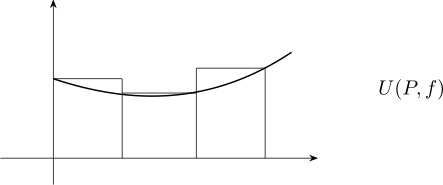
- \(\, U\big (P,f\big ) = \displaystyle {\sum ^n_{k =1}M_k(f)\,\Delta x_k}\,\) is called the upper sum of \(f\) for the partition \(P\).
- (ii).
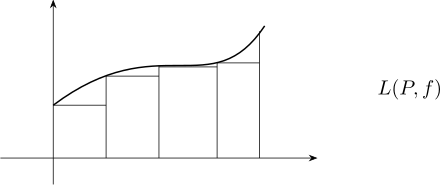
- \(\, L\big (P,f\big ) = \displaystyle {\sum ^n_{k =1}m_k(f)\,\Delta x_k}\,\) is called the lower sum of \(f\) for the partition \(P\)
Note that we always have \(\, m_k(f) \leq M_k(f)\,\) and since \(\,\Delta x_k\geq 0,\,\) we also have
\(\, m_k (f) \, \Delta x_k \leq M_k(f)\, \Delta x_k\).
It follows that the lower sums cannot exceed the upper sums. Further, if \(t_k \in [x_{k - 1}, x_k]\), then \(\, m_k(f) \leq f(t_k)\leq M_k(f)\). It follows that
\(\, L\big (P,f\big ) \leq S\big (P,f\big )\leq U\big (P,f\big )\).
Note. Geometrically, \(U\big (P,f\big )\) is the sum of the areas of circumscribed rectangles and \(L\big (P,f\big )\) is the areas of
the inscribed rectangles of the curve \(y = f(x)\) corresponding to the partition \(P\), if \(f\) is a continuous and
non negative on \([a,b]\).
Theorem 5.1.5. Let \([a,b]\) be a closed bounded interval, and let \(f\) be defined real-valued function on \([a,b]\) which is continuous and bounded. Then
- (i).
- If \(P^*\) is a refinement of a partition \(P\), we have \(\, U\big (P^*, f\big )\leq U\big (P,f\big )\,\) and
\(\, L\big (P^*,f\big )\geq L\big (P,f\big )\) - (ii).
- For any two partitions \(P_1\) and \(P_2\), we have \(\, L\big (P_1, f\big )\leq U\big (P_2,f\big )\)
Proof. To prove (i) it suffices to assume that \(P^*\) contains exactly one more point than \(P\), say the
point \(c\). Let \(c\) be in the \(j^{\text {th}}\) subinterval of \(P\). Then
\[U\big (P^*, f\big ) = \sum ^n_{\substack {k = 1\\ k\neq j}}M_k(f)\, \Delta x_k + M'\, (c - x_{k - 1}) + M''(x_k - c)\]
where \(M'\) and \(M''\) denote the supremum of \(f\) in \([x_{k - 1}, c]\) and \([c,x_k]\) respectively. But since \(M'\leq M_i(f)\) and \(M'' \leq M_i(f)\) we have \(\, U\big (P^*, f\big ) \leq U\big (P,f\big )\).
The inequality for the lower sum is proved in a similar way.
To prove (ii) Let \(\, P= P_1\cup P_2\). Then we have
\[L\big (P_1,f\big ) \leq L\big (P,f\big ) \leq U\big (P,f\big ) \leq U\big (P_2,f\big )\]
\([\)the lower sum of the refinement can not exceed that of the partition\(]\).
Remark. If
\begin {align*} M & = \sup \big \{f(x):\, x\in [a,b]\big \}\\ m & = \inf \big \{f(x):\, x\in [a,b]\big \} \end {align*}
and \(P_1\) and \(P_2\) are two partitions of \([a,b]\), then \(\, m(b-a)\leq L\big (P_1,f\big ) \leq U\big (P_2,f\big )\leq M(b-a)\)
□
Definition 5.1.6. Let \(f\) be a bounded function on a closed and bounded interval \([a,b]\). Then the
upper Riemann integral of \(f\) over \([a,b]\) is defined as
\[\overline {\int ^b_a}f(x)\, dx = \inf \Big \{U\big (P,f\big ):\, P\in \rho [a,b]\Big \}\]
The lower Riemann integral of \(f\) over \([a,b]\) is similarly defined to be
\[\underline {\int ^b_a}f(x)\, dx = \sup \Big \{U\big (P,f\big ):\, P\in \rho [a,b]\Big \}\]
That is, inf and sup taken over all possible partitions \(P\) of \([a,b]\).
For simplicity, we shall denote the upper Riemann integral of \(f\) in \([a,b]\) by \(\, \displaystyle {\overline {\int ^b_a} f}\,\) and the lower Riemann
integral by \(\, \displaystyle {\underline {\int ^b_a} f}\,\) .
Theorem 5.1.7. Let \(f\) be a bounded function on a closed and bounded interval \([a,b]\). Then
\[\, \displaystyle {\underline {\int ^b_a} f\, \leq \, \overline {\int ^b_a} f}\]
Proof. Let \(\varepsilon > 0\) be given. Then there is a partition \(P_1\) such that
\[U\big (P_1,f \big ) < \overline {\int ^b_a} f + \varepsilon \]
It follows that \(\, \displaystyle {\overline {\int ^b_a} f + \varepsilon }\,\) is an upper bound to all lower sum \(L\big (P_1,f\big )\). Hence
\[\underline {\int ^b_a} f \leq \overline {\int ^b_a} f + \varepsilon \]
since \(\varepsilon \) is arbitrary, this implies that
\[\, \displaystyle {\underline {\int ^b_a} f \leq \overline {\int ^b_a} f}\]
It is possible to have a strict inequality
\[\, \displaystyle {\underline {\int ^b_a} f < \overline {\int ^b_a} f}\]
□
Example 5.1.8. Let \(f\) be defined on \([0,1]\) as follows \[f(x)= \begin {cases} 1 & \text {if}\hspace {0.3cm} x\hspace {0.3cm}\text {is rational}\\\\ 0 & \text {if}\hspace {0.3cm} x \hspace {0.3cm} \text {is irrational}\\ \end {cases} \] Then for every partition \(P\) of \([0,1]\) we have \(M_k(f) = 1\) and \(m_k(f) = 0\)
since every subinterval contains both rational and irrational numbers. Therefore \(U\big (P,f\big ) = 1\) and \(L\big (P,f\big ) = 0\) for all \(P\).
It follows that on \([a,b] = [0,1]\)
\[\overline {\int ^b_a} f \, dx = 1\hspace {0.8cm}, \hspace {0.8cm}\underline {\int ^b_a} f\, dx = 0\]
Remark. If \(a< c < b\), then
- i).
- \(\, \displaystyle {\overline {\int ^b_a} f \, = \, \overline {\int ^c_a} f \, + \, \overline {\int ^b_c} f}\) (ii). \(\, \displaystyle {\underline {\int ^b_a} f \, = \, \underline {\int ^c_a} f \, + \, \underline {\int ^b_c} f}\)
However, some properties of upper and lower integrals differ from those of integrals
\[\overline {\int ^b_a} (f + g) \leq \overline {\int ^b_a} f \, + \, \overline {\int ^b_a} g\hspace {0.7cm}\text {and}\hspace {0.7cm}\underline {\int ^b_a} (f + g) \geq \underline {\int ^b_a} f \, + \, \underline {\int ^b_a} g\]
Definition 5.1.9. Let \(f\) be a bounded function on the closed bounded interval \([a,b]\). Then \(f\) is said
to be Riemann integrable on \([a,b]\) if
\[\underline {\int ^b_a} f\, dx \, = \, \overline {\int ^b_a} f\, dx\]
The common value of the upper and lower integrals is denoted by \(\, \displaystyle {\int ^b_a f}\,\) or \(\, \displaystyle {\int ^b_a f(x)\,dx}\,\) and is called the Riemann
integral of \(f\) with respect to \(x\) in \([a,b]\).
Proof. Let \(\, P:\, a = < x_0 < x_i < \cdots \cdots \cdots < x_k\,\cdots \cdots \, x_{n - 1} < x_n = b\, \) be any partition, then \begin {align*} U\big (P,f\big ) & = \sum ^n_{k = 1} M_k(f)\, \Delta x_k = \sum ^n_{k = 1} C\, \Delta x_k\\\\ & = C\, (b - a) \end {align*}
\begin {align*} L\big (P,f\big ) & = \sum ^n_{k = 1} m_k (f) \, \Delta x_k = \sum ^n_{k = 1} C\, \Delta x_k\\\\ & = C\, (b - a) \end {align*}
Since the partition \(P\) was arbitrary, we have \(U\big (P,f\big ) = L\big (P,f\big ) = C\, (b- a)\,\) for every partition \(P\) of \([a,b]\). Thus
\[\overline {\int ^b_a} f = C\, (b - a) = \underline {\int ^b_a} f\]
Therefore, \(f\) is Riemann integrable and
\[\, \displaystyle {\int ^b_a f(x)\, dx = C\, (b - a)}\]
□
Example 5.1.11. Let \(f(x) = x^2\) be a function defined on \([0,1]\). For each \(n\), let \(P_n\) be the the partition \(\, \Big \{0,\, \dfrac {1}{n},\, \dfrac {2}{n}, \, \cdots \cdots \, \dfrac {n - 1}{n}, \, \dfrac {n}{n}\Big \}\,\) of, the
closed bounded interval \([0,1]\). Compute \(\, \lim \limits _{n\rightarrow \infty }\, U\big (P_n,f\big )\,\) and \(\, \lim \limits _{n \rightarrow \infty }\, L\big (P_n,f\big )\).
Solution. The component intervals of the partition \(P_n\) are \(\, I_1 = \big [0\,,\,1/n\big ]\, , \hspace {0.3cm} I_2 = \big [1/n\,,\, 2/n\big ]\, , \hspace {0.3cm}\cdots \cdots \cdots \,,\\ \hspace {0.3cm} I_n = \big [(n - 1)/n\, ,\, n/n\big ]\). So that \(\, \Delta x_k = 1/n\,\) for \(\, k = 1,\, 2, \, \cdots \cdots \, , n\)
\[M_1(f) = \dfrac {1}{n^2}\hspace {0.3cm} , \hspace {0.3cm} M_2(f)= \Bigg (\dfrac {2}{n}\Bigg )^2\hspace {0.3cm},\, \cdots \cdots \cdots \, \hspace {0.3cm} M_k(f) = \Bigg (\dfrac {k}{n}\Bigg )^2\hspace {0.3cm},\hspace {0.3cm} M_n(f) = \Bigg (\dfrac {n}{n}\Bigg )^2\]
Also
\[m_1(f) = 0\hspace {0.3cm},\hspace {0.3cm}m_2(f)= \Bigg (\dfrac {1}{n}\Bigg )^2\hspace {0.3cm},\hspace {0.3cm} m_3(f) = \Bigg (\dfrac {2}{n}\Bigg )^2\hspace {0.3cm},\, \cdots \cdots \, , \hspace {0.3cm} m_k (f) = \Bigg (\dfrac {k - 1}{n}\Bigg )^2\hspace {0.3cm},\hspace {0.3cm}\]
\[ m_n(f) = \Bigg (\dfrac {n - 1}{n}\Bigg )^2\]
\begin {align*} U\big (P_n,f\big ) & = \sum ^n_{k = 1} M_k(f)\, \Delta x_k = \sum ^n_{k = 1}\Bigg (\dfrac {k}{n}\Bigg )^2\, \cdot \, \dfrac {1}{2}\\\\ & = \frac {1}{n^2}\, \cdot \, \dfrac {1}{n}\, + \, \Bigg (\dfrac {2}{n}\Bigg )^2\cdot \frac {1}{n}\, + \, \Bigg (\frac {3}{n}\Bigg )^2\cdot \frac {1}{n} \, + \, \cdots \cdots \, + \, \Bigg (\dfrac {n}{n}\Bigg )^2\, \cdot \, \dfrac {1}{n}\\\\ & = \dfrac {1}{n^3}\, \Big (1 + 2^2 + 3^2 + \cdots \cdots \cdots + n^2\Big )\\\\ & = \frac {1}{n^3}\, \Bigg (\dfrac {n\,(n + 1)\, (2n + 1)}{6}\Bigg )\\\\ & = \dfrac {n\, (n+1)\, (2n + 1)}{6\, n^3}\\\\ \therefore \hspace {0.3cm} U\big (P_n,f\big ) & = \dfrac {\dfrac {n}{n}\, \Big (\dfrac {n + 1}{n}\Big )\, \Big (\dfrac {2n + 1}{n}\Big )}{6} \end {align*}
Taking the limit as \(\, n \longrightarrow \infty \) \[\lim _{n\rightarrow \infty }\,U\big (P_n,f\big ) = \lim _{n\rightarrow \infty }\,\dfrac {\dfrac {n}{n}\, \Big (\dfrac {n + 1}{n}\Big )\, \Big (\dfrac {2n + 1}{n}\Big )}{6} = \frac {1\, (2)}{6} = \frac {1}{3}\]
Similarly, \begin {align*} L\big (P_n,f\big ) & = \sum ^n_{k = 1}m_k(f)\, \Delta x_k = \sum ^n_{k = 1}\Bigg (\frac {k - 1}{n}\Bigg )^2\,\cdot \,\dfrac {1}{n}\\\\ & = \frac {0}{n^2}\,\cdot \, \dfrac {1}{n}\, + \, \frac {1}{n^2}\, \cdot \, \frac {1}{n}\, + \, \Bigg (\frac {2}{n}\Bigg )^2\,\cdot \, \frac {1}{n} \, + \, \cdots \cdots \cdots \, + \, \Bigg (\frac {n - 1}{n}\Bigg )^2\,\cdot \,\frac {1}{n}\\\\ & = \frac {1}{n^3}\,\,\Big ( 0 + 1^2 + 2^2 + 3^2 + \,\cdots \cdots \cdots \, + \big (n - 1\big )^2\Big )\\\\ & = \frac {1}{n^3}\,\,\Big (1^2 + 2^2 + 3^2 + \,\cdots \cdots \cdots \, + \, \big (n - 1\big )^2\Big )\\\\ & = \frac {1}{n^3}\, \,\Bigg (\dfrac {n\, (n + 1)\, (2n + 1)}{6}\Bigg )\\\\ & = \frac {n\, (n + 1) \, (2n + 1)}{6\, n^3}\\\\ \end {align*}
Theorem 5.1.12. Let \(f\) be a bounded function defined on a closed and bounded interval \([a,b]\). Then
\(f\) is Riemann integrable on \([a,b]\) if and only if for every \(\varepsilon >0\), there is a partition \(P\) of \([a,b]\) such that \(\, U\big (P, f\big ) - L\big (P,f\big ) < \varepsilon \).
Proof. We already have seen that \(\, \displaystyle {\underline {\int ^b_a} f(x)\, dx \, \leq \, \overline {\int ^b_a} f(x)\, dx}\hspace {0.3cm}\cdots \cdots \cdots \hspace {0.3cm} (1)\)
Suppose now that \(\varepsilon > 0\) is such that there is a partition \(P\) for which \(\, U\big (P,f\big ) - L\big (P, f\big ) < \varepsilon \,\) since \(\, \displaystyle {\overline {\int ^b_a} f(x) \, dx \, \leq \, U\big (P,f\big )}\,\) and \(\, \displaystyle {\underline {\int ^b_a} f(x)\,dx\, \geq \, L\big (P,f\big )}\), then we have \(\,\displaystyle {\overline {\int ^b_a}f(x)\, dx\, -\, \underline {\int ^b_a}f(x)\, dx}\, < \varepsilon \) Since
\(\varepsilon > 0\) is arbitrary, we get
\[\overline {\int ^b_a}f(x)\, dx \, \leq \, \underline {\int ^b_a}f(x)\, dx \hspace {0.3cm}\cdots \cdots \cdots \hspace {0.3cm} (2)\]
Hence from (1) and (2) we get
\[\underline {\int ^b_a}f(x)\, dx\, = \, \overline {\int ^b_a}f(x)\, dx\]
So that \(f\) is Riemann integrable on \([a,b]\).
Conversely, suppose that \(f\) is Riemann integrable on \([a,b]\). Then we have \begin {align*} \overline {\int ^b_a}f(x)\, dx \, & = \inf _P\, U\big (P_1,f\big )\\\\ & = \sup _P\, L\big (P_2,f\big )\\\\ & = \underline {\int ^b_a}f(x)\, dx \end {align*}
Let \(\varepsilon > 0\) be given, then we can choose partitions \(P_1\) and \(P_2\) such that \(\, \displaystyle {U\big (P_1,f\big ) < \overline {\int ^b_a}f(x)\, dx \, + \, \frac {\varepsilon }{2}}\,\) and \(\, \displaystyle {L\big (P_2,f\big ) > \underline {\int ^b_a}f(x)\, dx\, - \, \frac {\varepsilon }{2}}\). Since \(f\) is Riemann integrable, we
have
\[U\big (P_1,f\big ) - \frac {\varepsilon }{2}< \overline {\int ^b_a}f(x)\, dx = \underline {\int ^b_a}f(x)\, dx < L\big (P_2,f\big ) + \frac {\varepsilon }{2}\]
That is \(\, U\big (P_1,f\big ) - \varepsilon /2 < L\big (P_2,f\big ) + \varepsilon /2\)
Now, considering the common partition of \(P_1\) and \(P_2\) we have
\[U\big (P_1\cup P_2,f\big ) - \frac {\varepsilon }{2} < L\big (P_1\cup P_2,f\big ) + \frac {\varepsilon }{2}\]
Let \(P_1\cup P_2\) be a single partition \(P\). Then
\[U\big (P,f\big ) - \frac {\varepsilon }{2} < L\big (P,f\big ) + \frac {\varepsilon }{2}\]
This gives \(\, U\big (P,f\big ) - L\big (P,f\big ) < \varepsilon \).
□
Proof. Recall that a continuous function on a closed bounded interval is uniformly continuous
there.
Suppose that \(f\) is continuous on \([a,b]\) and let \(\varepsilon > 0\) be given, we show that corresponding to this \(\varepsilon > 0\), there is
partition \(P\) such that \(\, U\big (P,f\big ) - L\big (P,f\big ) < \varepsilon \) and then by the above Theorem shall conclude that \(f\) is Riemann integrable on
\([a,b]\).
Now by uniform continuity of \(f\) on \([a,b]\), there is a \(\delta > 0\) such that if \(x, \, y\in [a,b]\) with \(\begin {vmatrix} x - y\\ \end {vmatrix} < \delta \) then \(\begin {vmatrix} f(x) - f(y)\\ \end {vmatrix} < \dfrac {\varepsilon }{b - a}\).
Let \(P\) be any partition of \([a,b]\) with \(\begin {vmatrix} \begin {vmatrix} P\\ \end {vmatrix} \end {vmatrix} < \delta \). By the property of continuous functions, on a closed bounded interval \([x_{k -1}, x_k]\),
there exists points \(x_k'\) and \(x_k''\) such that \(\, f(x_k') = M_k\,\) and \(\, f(x_k'') = m_k\). Now \begin {align*} \begin {vmatrix} x_k' - x_k''\\ \end {vmatrix} \, & \leq \begin {vmatrix} x_k - x_{k - 1}\\ \end {vmatrix} = \begin {vmatrix} \Delta x_k\\ \end {vmatrix}\\ & < \begin {vmatrix} \begin {vmatrix} P\\ \end {vmatrix} \end {vmatrix}\\ & < \delta \end {align*}
Hence \(\, M_k - m_k = \begin {vmatrix} f(x_k') - f(x''_k)\\ \end {vmatrix} < \dfrac {\varepsilon }{b - a}\,\) for \(\, k = 1,\, 2,\, \cdots \cdots \cdots \, n\). Thus \begin {align*} U\big (P,f\big ) - L\big (P,f\big ) \, & = \sum ^n_{k = 1}\Big [M_k(f) - m_k(f)\Big ]\,\begin {vmatrix} \Delta x_k\\ \end {vmatrix}\\\\ & = \sum ^n_{k = 1}\begin {vmatrix} f(x'_k) - f(x''_k)\\ \end {vmatrix}\, \begin {vmatrix} \Delta x_k\\ \end {vmatrix}\\\\ & < \dfrac {\varepsilon }{b - a}\, \sum ^n_{k = 1}\begin {vmatrix} \Delta x_k\\ \end {vmatrix}\\\\ & = \dfrac {\varepsilon }{b - a}\, (b - a) = \varepsilon \end {align*}
Thus \(\, U\big (P,f\big ) - L\big (P,f\big ) < \varepsilon \).
Hence from the above theorem, \(f\) is Riemann integrable on \([a,b]\).
□
Proof. If \(f\) is a constant function on \([a,b]\) then it is Riemann integrable on \([a,b]\) by earlier example.
Assume that \(f\) is monotone increasing function on \([a,b]\) and \(f(a) < f(b)\).
Let \(\varepsilon > 0\) be given and let \(P\) be a partition on \([a,b]\) with \(\begin {vmatrix} \begin {vmatrix} P\\ \end {vmatrix} \end {vmatrix} = \dfrac {\varepsilon }{f(b) - f(a)}\). Since \(f\) is increasing on \([a,b]\) we have on \([x_{k - 1}, x_k]\, ,\hspace {0.2cm} M_k(f) =f(x_k)\) and \(m_k(f) = f(x_{k-1})\,\)
for
\(\, k = 1,\, 2,\, \cdots \cdots \cdots \, n\). Hence \begin {align*} U\big (P,f\big ) - L\big (P,f\big ) \, & = \sum ^n_{k = 1} M_k(f)\, \begin {vmatrix} \Delta x_k\\ \end {vmatrix}\, -\, \sum ^n_{k = 1} m_k(f)\, \begin {vmatrix} \Delta x_k\\ \end {vmatrix}\\\\ & = \sum ^n_{k = 1} \Big [M_k(f) - m_k(f)\Big ]\, \Delta x_k = \sum ^n_{k = 1} \Big [f(x_k) - f(x_{k - 1})\Big ]\, \Delta x_k\\\\ & < \frac {\varepsilon }{f(b) - f(a)}\, \sum ^n_{k = 1} \Big [f(x_k) - f(x_{k - 1})\Big ]\\\\ & = \dfrac {\varepsilon }{f(b) - f(a)}\, \big (f(x_n)-f(x_0)\big )\\\\ & = \dfrac {\varepsilon }{f(b) - f(a)}\, \big (f(b) - f(a)\big ) = \varepsilon \end {align*}
That is \(\, U\big (P,f\big ) - L\big (P,f\big ) < \varepsilon \) and so by earlier Theorem, \(f\) is Riemann integrable on \([a,b]\).
\(*\) Prove for the decreasing function.
□
Example 5.1.15. Let \(f\) be a continuous function on \([0,1]\) and let \(\sigma _n = \Big \{0\, ,\, \dfrac {1}{n}\, ,\, \dfrac {2}{n}\, , \, \cdots \cdots \, \dfrac {n}{n}\Big \}\) be a partition of \([0,1]\). Let \(x^*_k\) be any point in the interval \(\, \Big [\dfrac {k - 1}{n}\, , \, \dfrac {k}{n}\Big ]\)
- i).
- Prove that \(\, L\big (\sigma _n, f\big ) \leq \dfrac {1}{n}\, \sum \limits _{k =1}^n f(x^*_k) \leq U\big (\sigma _n,f\big )\)
- ii).
- hence show that \(\, \displaystyle {\lim _{n\rightarrow \infty }\dfrac {1}{n}\, \sum ^n_{k = 1} f(x^*_k) = \int ^1_0f(x)\, dx}\)
Proof.
- i).
- To get the first inequality, \(\, L\big (\sigma _n, f\big ) \leq \dfrac {1}{n}\, \sum \limits ^n_{k = 1} f(x^*_k)\, \), note that \(\, m_k(f)\leq f(x^*_k)\,\) so that \begin {align*} \sum ^n_{k = 1} m_k(f)\, \Delta x_k & \leq \sum ^n_{k = 1}f(x^*_k)\, \Delta x_k\\\\ \implies \hspace {0.4cm} \sum ^n_{k = 1}m_k(f)\, \Delta x_k & \leq \dfrac {1}{n}\, \sum ^n_{k = 1}f(x^*_k)\\\\ \implies \hspace {0.4cm} L\big (\sigma _n, f\big ) & \leq \dfrac {1}{n}\,\sum ^n_{k = 1} f(x^*_k) \end {align*}
The second inequality \(\, \displaystyle {\dfrac {1}{n}\, \sum ^n_{k = 1}f(x^*_k) \leq U\big (\sigma _n , f)}\,\) is obtained in a similar fashion since \(\, f(x^*_k) \leq M_k(f)\,\) for each \(k\).
Hence \(\, \displaystyle {L\big (\sigma _n, f\big ) \leq \frac {1}{n}\, \sum ^n_{k = 1} f(x^*_k) \leq U\big (\sigma _n, f)}\,\) as required.
- ii).
- Since \(f\) is continuous on \([0,1]\) it is bounded on \([0,1]\), given a \(\varepsilon > 0\) there exits a partition such that \(\, U\big (\sigma _n, f\big ) - L\big (\sigma _n,f\big )< \varepsilon \, \). But
\(\, \displaystyle {L\big (\sigma _n,f\big )\leq \int ^1_0f(x)\, dx}\)
\(\displaystyle {\implies \hspace {0.2cm} U\big (\sigma _n,f\big ) - \int ^1_0f(x)\, dx < \varepsilon }\,\) for large \(n\) \[U\big (\sigma _n, f\big ) - L\big (\sigma _n,f\big ) < \varepsilon \] \[U\big (\sigma _n,f\big ) - \int ^1_0f(x)\, dx \, + \, \int ^1_0f(x)\, dx - L\big (\sigma _n,f\big ) < \varepsilon \] But \(\,\, \displaystyle {\int ^1_0f(x)\, dx \, -\, L\big (\sigma _n,f\big ) >0}\). Therefore \(\, \displaystyle {U\big (\sigma _n,f\big ) \, - \, \int ^1_0f(x)\, dx < \varepsilon }\)
Therefore \(\hspace {0.2cm}\displaystyle {\lim _{n\rightarrow \infty }\, U\big (\sigma _n, f\big ) = \int ^1_0 f(x)\, dx}\hspace {0.3cm}\cdots \cdots \cdots \hspace {0.3cm} (A)\)
Similarly \(\, \, \displaystyle {\int ^1_0f(x)\, dx - L\big (\sigma _n, f\big ) < \varepsilon }\hspace {0.2cm}\) so that \(\hspace {0.2cm} \displaystyle {\int ^1_0f(x)\, dx = \lim _{n\rightarrow \infty } L\big (\sigma _n,f\big )}\hspace {0.3cm}\cdots \cdots \hspace {0.2cm} (B)\)
Combining \((A)\) and \((B)\) gives \[\int ^1_0f(x)\, dx \leq \lim _{n\rightarrow \infty }\, \dfrac {1}{n}\, \sum ^n_{k = 1} f(x^*_k) \leq \int ^1_0f(x)\, dx\]
Hence \(\hspace {0.3cm}\displaystyle {\lim _{n\rightarrow \infty } \, \frac {1}{n}\, \sum ^n_{k = 1}f(x^*_k)=\int ^1_0f(x)\, dx}\)
Example 5.1.16. Let \(\, f:\, [0,1]\longrightarrow \mathbb {R}\,\) be defined by \[f(x) = \begin {cases} \dfrac {\sin x}{x} & \text {if}\hspace {0.2cm} x\neq 0\\\\ 1 & \text {if}\hspace {0.2cm} x = 0\\ \end {cases} \] Prove that \(f\) is Riemann integrable on \([0,1]\).
Proof. Since \(\, \sin x/x \, \) is continuous for all \(x\neq 0\) and \(\, \lim \limits _{x\rightarrow 0} \dfrac {\sin x}{x} = 1 = f(0),\,\) we see that \(f\) is continuous on a closed bounded interval
\([0,1]\). Therefore, \(f\) is Riemann integrable on \([0,1]\).
□
- i).
- Consider the functions \(f\) defined on the interval \([0,1]\) by
\(f(x) = 1 \) when \(x\) is rational
\(f(x) = 0\) when \(x\) is irrationalThen \(f\) is a bounded function on \([0,1]\). However, \(f\) is not Riemann integrable on \([0,1]\).
- ii).
- We give an example of a function which is not continuous but Riemann integrable.
Let \(f(x) = 1\) if \(x\in \big [0\, ,\, 1/2\big ]\) and \(f(x) = 0\) if \(x\in \big (1/2\, ,\, 1\big ]\). Then \(f\) is not continuous at \(x=1/2\), since left limit is not equal to right limit. To see that \(f\) is Riemann integrable consider any partition \(P\) of \([0,1]\) given by \[\, P:\, 0 = x_0 < x_1 < \cdots \cdots \, < x_{k - 1} < x_k < \, \cdots \cdots \, < x_n = 1\] Suppose that \(\, 1/2\in \big [x_{k - 1},x_k\big )\) in the partition. Then in \(\, [x_{k - 1}, x_k)\,,\hspace {0.2cm} M_k(f) = 1\) and \(m_k(f) = 0\). We also have \(M_i(f) = m_i(f) = 1\,\) in \([x_{i - 1}, x_i]\) for \(i = 1,\, 2,\, \cdots \cdots \cdots \, k-1\,\) and \(\, M_i(f) = m_i(f) = 0\,\) for \(\, i = k,\cdots \cdots \, n\). Then \begin {align*} U\big (P,f\big ) & = (x_1 - x_0) +\, \cdots \cdots \cdots \, + (x_k - x_{k - 1}) + 0 + \cdots \cdots + 0 = x_k\\ L\big (P,f\big ) & = (x_1 - x_0) +\, \cdots \cdots \cdots \, + (x_{k-1} - x_{k -2}) + 0 + \cdots \cdots + 0=x_{k -1} \end {align*}
It follows that \(\hspace {0.2cm}\displaystyle {\overline {\int ^1_0}f(x)\,dx = \inf \, U\big (P,f\big ) = 1}\) \[\underline {\int ^1_0}f(x)\,dx = \sup \, L\big (P,f\big ) = 1\] Hence \(\hspace {0.2cm} \displaystyle {\overline {\int ^1_0}f(x)\,dx = 1 = \underline {\int ^1_0}f(x)\,dx\hspace {0.2cm}}\) and \(f\) is Riemann integrable on \([0,1]\).
Theorem 5.1.18. A bounded function on \([a,b]\) is Riemann integrable if on \([a,b]\)
- (i).
- it has a finite set of points of discontinuity.
- (ii).
- its set of points of discontinuity has a finite number of limit points.
Proof.
- (i).
- If \(f\) is discontinuous on \([a,b]\) then
\[M = \sup \big \{f(x):\, x\in [a,b]\big \} \neq \inf \big \{f(x):\, x\in [a,b]\big \} = m\]
Let \(\, \big \{\alpha _1,\, \alpha _2,\, \cdots \cdots \cdots ,\, \alpha _p\big \}\,\) be the ordered set of \(p\) points of discontinuity of \(f\) on \([a,b]\). Let \(\alpha _1\neq a\) and \(\alpha _p \neq b\). For \(\varepsilon > 0\), enclose these
points of discontinuity in non-overlapping subintervals \(\, [x_1', x''_1]\,,\, [x'_2,x_2'']\, ,\cdots \cdots \cdots ,\, [x_p',x_p'']\,\) of \([a,b]\) such that their total length is
less than \(\, \dfrac {\varepsilon }{2\, \big (M - m\big )}\)
\[\text {i.e}\hspace {0.5cm}\sum ^p_{k = 1}(x''_k - x'_k)\, < \, \dfrac {\varepsilon }{2\, \big (M - m\big )}\]
The function is then continuous on each of the \(p + 1\) subintervals \(\, [a,x_1']\, ,\, [x''_1,x'_2]\, ,\, [x''_2,x'_3]\, , \cdots \, [x''_p,b]\), so for \(\varepsilon > 0\) there exists partitions
\(\, P_1,\, P_2,\, \cdots \cdots \cdots ,\, P_{p+1}\,\) of the subinterval such that
\[U\big (P_r,f\big ) - L\big (P_r,f\big ) < \dfrac {\varepsilon }{2\,\big (p+1\big )}\hspace {0.4cm} r =1,\, 2,\, \cdots \cdots \cdots ,\, p + 1\]
Then for the partition \(\, P= \big \{a = x_0,\, x_1,\, \cdots \cdots \cdots ,\, x_1',\, x_p',\, x_p'',\, \cdots \, x_n = b\big \}\,\) of \([a,b]\) we have \begin {align*} U\big (P,f\big ) - L\big (P,f\big ) & = \sum ^p_{r=1} M_r'(f)\, \big (x''_r-x'_r\big ) + \sum ^{p+ 1}_{r=1}U\big (P_r,f\big ) - \sum ^p_{r=1}m'_r(f)\,\big (x''_r-x'_r\big ) - \sum ^{p + 1}_{r=1}L\big (P_r,f\big )\\\\ & = \sum ^p_{r=1}\big (M'_r(f) - m'_r(f)\big )\,\big (x''_r-x'_r\big ) + \sum ^{p + 1}_{r=1}\Big (U\big (P_r,f\big ) - L\big (P_r,f\big )\Big ) \end {align*}
where \(\hspace {0.2cm}M'_r(f) = \sup \big \{f(x):\, x\in [x'_r,x''_r]\big \}\,\) and \(m'_r(f) = \inf \big \{f(x):\, x\in [x'_r,x''_r]\big \}\,\). Thus \begin {align*} U\big (P,f\big ) - L\big (P,f\big ) & < \sum ^p_{r=1}\big (M -m\big )\, \big (x''_r-x'_r\big ) + \dfrac {\varepsilon }{2\, \big (p + 1\big )}\, \cdot \, \big (p + 1\big )\\\\ & < \big (M-m\big ) \, \dfrac {\varepsilon }{2\big (M -m\big )}\, + \, \frac {\varepsilon }{2} = \varepsilon \end {align*}
Hence \(f\) is Riemann integrable.
The case \(\alpha _1 = a\) or \(\alpha = b\) can easily be dealt with by slight modifications in the above arguments for \(x'_1 = a\) or \(x''_p = b\).
- (ii).
- To prove the second part, let \(\big \{\alpha _1,\, \alpha _2,\, \cdots \cdots \cdots \, \alpha _p\big \}\) be the ordered set of finite number of limit points of the set of
discontinuities of \(f\) on \([a,b]\). Let \(\alpha _1\neq a\) or \(\alpha _p\neq b\). For \(\varepsilon >0\) enclose there are limit points in \(P\) non-overlapping
subintervals \([x_1',x_1'']\, ,\, [x'_2,x_2'']\, \cdots \cdots ,\, [x_p',x_p'']\,\) such that their total length is less than \(\, \dfrac {\varepsilon }{2\,\big (M-m\big )}\)
\[\text {i.e}\hspace {0.5cm}\sum ^p_{k = 1}\big (x''_k - x'_k\big ) \, < \, \dfrac {\varepsilon }{2\, \big (M-m\big )}\]
In each of the remaining \(p + 1\) subintervals \([a,x_1']\, ,\, [x_1'',x'_2]\, , \, \cdots \cdots \cdots \, [x''_p, b]\) of \([a,b]\hspace {0.2cm} f\) has only a finite number of points of discontinuity so
that each of these \(p+1\) subintervals can be partitioned to \(P_1,\, P_2,\, \cdots \cdots \cdots \, P_{p+1}\) such that
\[U\big (P_r,f\big ) - L\big (P_r,f\big ) < \dfrac {\varepsilon }{2\big (p + 1\big )}\hspace {0.2cm} r = 1,\, 2,\, \cdots \cdots \cdots \, p+1\]
Then for the partition \(P\) as in (i) we get \(\, U\big (P,f\big ) - L\big (P,f\big ) < \varepsilon \).
Hence \(f\) is Riemann integrable.
Questions on this section
Stuck on something here? Ask below and it stays attached to this topic.