4.3 Local Maximum and Local Minimum
Definition 4.3.1. Let \(f:\, S\longrightarrow \mathbb {R}\) be a real-valued function and let \(c\in S\) be an interior point of \(S\). Then we say
- (i).
- \(f\) has a local maximum at \(c\) if there is a real number \(R\) such that \(\, \big (c - R\, , \, c + R\big ) \subset S\) and \(f(x) \leq f(c)\) for all \(x \in \big (c-R\, ,\, c + R\big )\)
- (ii).
- \(f\) has a local minimum at \(c\) if there is a real number \(r\) such that \((c - r\, ,\, c + r)\subset S\) and \(f(x)\geq f(c)\) for all \(x\in (c - r\, , \, c + r)\).
Remark. A function \(f:\, S\longrightarrow \mathbb {R}\) is said to have a global maximum at \(c\) if \(f(x)\leq f(c)\) for all \(x\in S\) and \(c\) is not necessary an interior point of \(S\). If \(f(x) \geq f(c)\) for all \(x\in S\) then \(f\) is said to have a global minimum at \(c\).
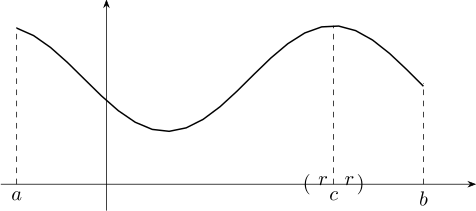
Theorem 4.3.2. Let \(f:\, S\longrightarrow \mathbb {R}\) be a real-valued function and let \(c\in S\) be an interior point of \(S\). If \(f\) has a local
maximum (or local minimum) at \(c\) and if \(f'(c)\) exists, then \(f'(c) = 0\).
Proof. Since \(f\) has a local maximum at \(c\) there is some real number \(R\) such that \((c - R\, ,\, c+ R)\subseteq S\) and \(f(x) \leq f(c)\) for all \(x\) such
that \(c- R < x < c + R\). Thus if \(c - R < x < c\) then
\[\dfrac {f(x) - f(c)}{x - c}\geq 0\]
Since \(f'(c)\) exists, we have
\[f'(c) = \lim _{x\rightarrow c^-} \, \frac {f(x) - f(c)}{x - c}\geq 0\]
Thus \(f'(c) \geq 0\hspace {0.3cm} \cdots \cdots \hspace {0.3cm} (I)\)
Similarly if \(c < x < c + R\) then \(\hspace {0.3cm} \dfrac {f(x) - f(c) }{x - c} \leq 0\hspace {0.2cm}\) so that \(\hspace {0.3cm}\displaystyle { f'(c) = \lim _{x\rightarrow c^+} \, \frac {f(x) - f(c)}{x - c}\leq 0}\)
i.e \(\hspace {0.3cm} f'(c)\leq 0\hspace {0.3cm} \cdots \cdots \hspace {0.3cm} (II)\)
The fact that \(f'(c)\) exists means that \(f'(c)\) must satisfy \((I)\) and \((II)\). That is \(\, 0 \leq f'(c) \leq 0\). Hence we conclude that \(\, f'(c) = 0\).
Prove for the local minimum case as an exercise.
□
Theorem 4.3.3 (Intermediate Value Theorem for Derivatives). Let \(I\subset \mathbb {R}\) be an open interval and
suppose that \(f:\, I \longrightarrow \mathbb {R}\) is differentiable on \(I\). If \(a, \, b\in I\) and \(K\) is a real number such that \(f'(a) < K < f'(b)\) then there is a point \(c\in (a,b)\)
such that \(f'(c) = K\).
Proof. Define a function \(F:\, I\longrightarrow \mathbb {R}\) by \(F(x) = f(x) - K\, x\). Then \(F'(a) = f'(a) - K < 0\) and \(F'(b) = f'(b) - K > 0\). Since
\[\frac {F(a + h) - f(a)}{h} \, \longrightarrow \, F'(a)\hspace {0.3cm}\text {as}\hspace {0.3cm} h \longrightarrow 0\]
We have \(F(a+h) - F(a) < 0\) for \(h>0\) and sufficiently small. Similarly
\[\frac {F(b + h) - f(b)}{h} \, \longrightarrow \, F'(b)\hspace {0.3cm}\text {as}\hspace {0.3cm} h \longrightarrow 0\]
Then we have \(F(b + h) - F(b) < 0\) for \(h < 0\) and sufficiently small. So, we can find \(t_1,\, t_2\in (a,b)\) such that \(F(t_1) < F(a)\) and \(F(t_2) < F(b)\). Since \(F\) is differentiable
on \(I\) from the definition, it is continuous on \(I\). The fact that \(F(t_1) < F(a)\) and \(F(t_2) < F(b)\), we can find a point \(c\) with \(a < c < b\)
where \(F\) has a local minimum i.e where \(F(c)\) is local minimum. Thus \(F'(c) = 0\) at this point. In other words \(\hspace {0.2cm} 0 = F'(c) = f'(c) - K\hspace {0.2cm}\)
i.e \(f'(c) = K\).
□
Questions on this section
Stuck on something here? Ask below and it stays attached to this topic.